Sunday, 22 June 2014

The Pear Tree Juveniles !!!


I always keep one eye on the garden pear tree, so to speak, 

there always seems to be something going on,
at the moment the numbers of Ring necked Parakeets seem to be increasing, and unlike some people, I love them in the garden, I can watch their antics for ages.
They seem to be testing the ripeness of the pears at the moment, 
I have a feeling there will not be many wasted this year.


The other garden birds seem to ignore their exotic cousins, 
although this Great Spotted woodpecker seems to be keeping an eye on them too.


The Great spotted Woodpecker after an absence of several months, has reappeared in the garden, bringing with him a juvenile, I just managed to get this fuzzy picture of them together.


The juvenile is the one with the red cap on its head, now coming to the garden regularly feeding on the peanut feeders.


While watching the woodpeckers, the adult male was seen to fly from the peanut feeder and appeared to be feeding or introducing the juvenile to the taste of peanuts, I managed to get a photograph of this, but while reviewing the photograph, to my horror I deleted it by mistake.


Starlings as always, arguing amongst themselves.


Only one juvenile Robin seen in the garden so far, this one has learnt already to perch on the feeder for mealworm treat.


And my favourite pictures of the day, was this House Sparrow family which arrived on the pear tree,
and were fed from the fat ball feeders.


Saturday, 21 June 2014

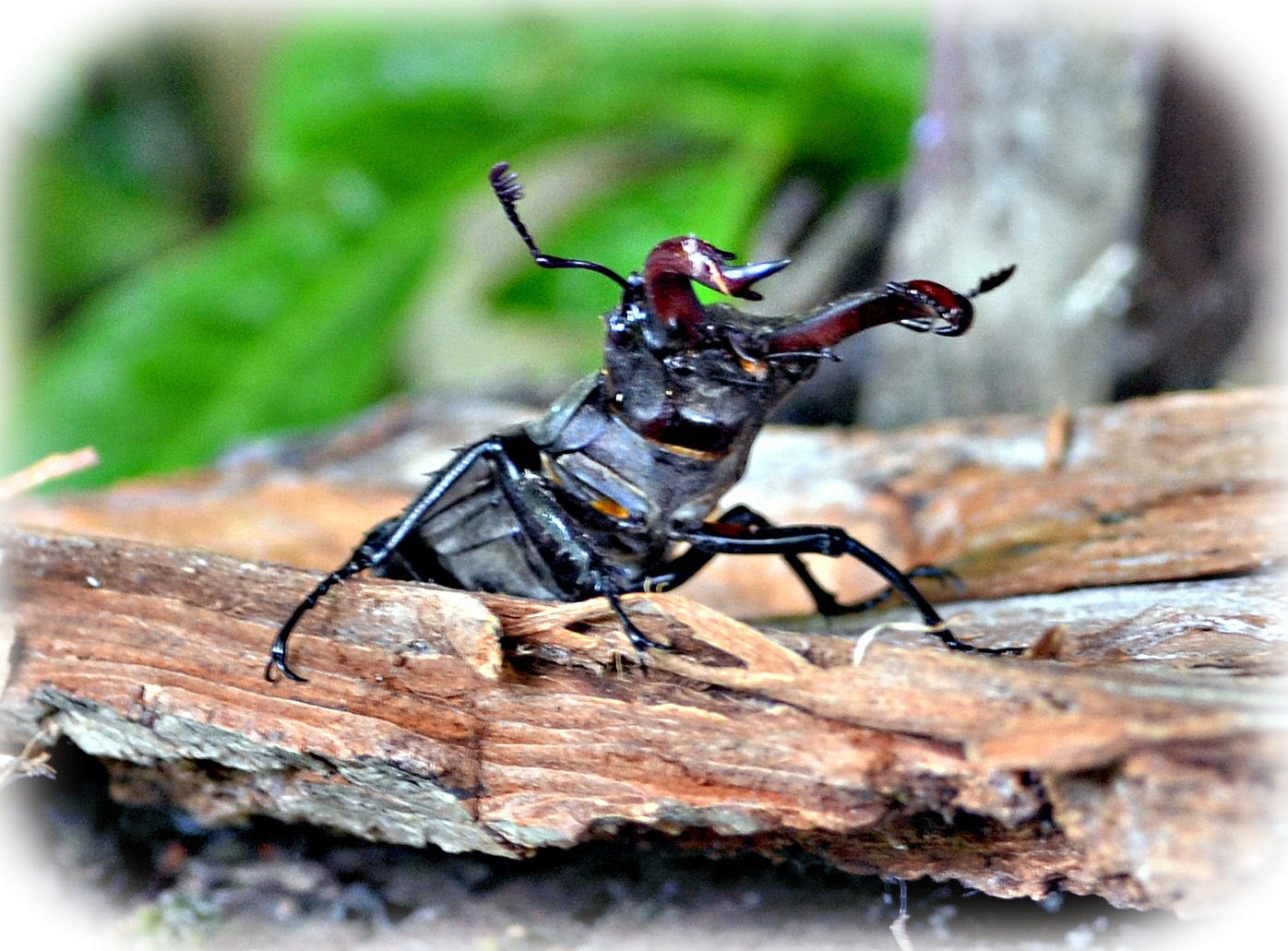
Greater Stag Beetle !!!


You cannot help but admire this spectacular looking Beetle, known as the Stag Beetle because its mandibles resemble the antlers of a Stag,  and as ferocious as it looks, it is quite harmless.

Also known as the "Thunder beetle," "Oak Ox," and "Horse Pincher" this protected species is one of our largest terrestrial beetles, found mainly in the south of England, its spends most of its seven year life cycle as a large white grub, living underground  chewing its way through dead wood . As it nears the end of its life cycle, it pupates in the autumn and metamorphosis as the adult beetle, the following summer.

The last few weeks of its life are spent in a desperate struggle to find a female and to mate. To this end, usually on a hot, humid thundery evening, the males take to the air in their search for a female.

 The female releases a pheromone perfume to attract the males, and this is where the large mandibles come into play, its possible that the females perfume attracts more than one male, so they engage in a form of wrestling match, trying to flip their opponent over on to its back, the winner mates with the female who then searches for a suitable habitat to lay her eggs, and the cycle begins again.


The adults do not usually survive the winter months.


This adult Male, gate crashed a garden party, where it was not particularly welcome, so a big thank you to Lorraine for giving me a chance to take a close look at this magnificent beast.


And a happy ending, The Stag Beetle spent the day on  the log pile at the bottom of the garden, taking wing that evening to continue his search for that elusive female.


The female Stag Beetle below, turned up in my garden last year, as you can see smaller mandibles, which can give you a nip.


How can we help these magnificent Beetles, check out the diagram below, the larvae only eat dead wood and cause no harm to living wood, so make a log pile, and provide some much needed deadwood habitat.


Give nature a home !

Saturday, 14 June 2014

A look at Orchids !!!


I decided back in May, to have a closer look at Orchids.
 Kent is renowned for its Orchids, if you know where to look,
 and even then, its not easy to track them down.

 I have only  managed to look at the Bonsai Bank, Denge , and the Orchid Bank at Lullingstone, and now as the Orchid seasons draws  to a close, I do not hold out much hope of seeing many more Orchids this year.

I have managed to track down some other venues for next year,  Hutchinson's Bank near Croydon, ParkGate Down or Hector Wilks Reserve, near Elham Kent, and Sandwich Bay to name a few.

There are still many Orchids that have eluded me,  Lizard Orchid, Man Orchid, Monkey Orchid, Fly Orchid, Bee Orchid and Spider Orchid, to name a few that I would love to see in there natural environment, and these are all within the realms of possibility, but these will have to wait until next year.

So as a complete novice, these are the Orchids I have managed to see and photograph this year. with a pleasant surprise near the end.

On my first visit to Bonsai Bank at the beginning of May, the only Orchids I could find were about nine or ten spikes of the
Early Purple Orchid, and most of these were past their best, so maybe an earlier visit next year.


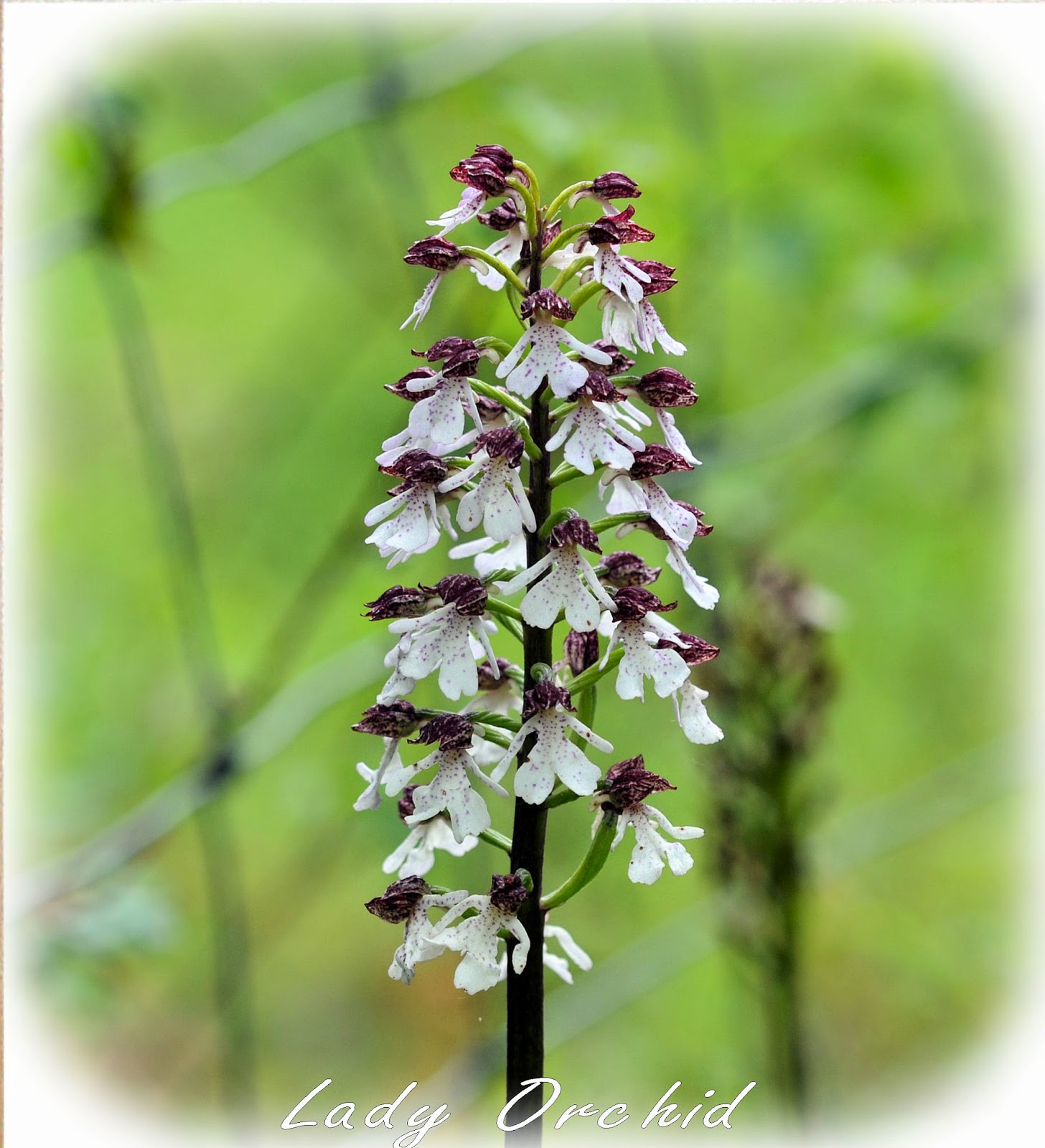
I only managed to find one flowering Lady Orchid at this time.


On my second visit  to the Bonsai Bank, three weeks into May, things had drastically changed, there were Lady Orchids everywhere on the Bank, much the most common Orchid on view.


A close view of the flower spike shows the individual flowers,
very lady like in there appearance


Another attractive Orchid on show was this 
 Greater Butterfly Orchid, quite prominent on the grassy bank and easy to pick out.


Another Orchid found was this Fragrant Orchid, and as the name suggests it did have a pleasant fragrance.


Nearing the end of May, another visit to the Bank , this time with my wife, and again the view had changed, many of the Lady Orchids and Greater Butterfly Orchids were past their Best.
It was now the turn of the Common Spotted Orchid to show, and they were everywhere and made a very attractive view.


Also on show on the grassy banks were these Common Twayblade,
not very impressive but part of the Orchid family


This next member of the Orchid family was pointed out to me by another enthusiast , White Helleborine, and reading up on this one it states that the  flowers rarely fully open.
Not so common, found about four or five specimens.


On my last visit to Bonsai Bank, I came across an Orchid that was just  beginning to open its flowers, much darker than the Fragrant Orchids near by, it just did not seem to fit the descriptions of the local orchids that you would expect to see here on the Bonsai Bank.


I don't know why, but I thought I would send the photograph to the warden who looks after the reserve, Abe Jupp to see if he could identify it for me.

To my surprise he was unfamiliar with it, he thought it may be a hybrid of some sort, but would forward it on to a botanist friend for identification.

A further surprise when I received another email from Abe Jupp 

" Your orchid has been confirmed as Southern Marsh Orchid by Alfred Gay- an unusual record for a dry chalky site and a first for Denge Woods I think. Thanks very much for sending in your useful sighting and keep them coming if you can- I suspect this one is so unusual it may well make the Kent Botany 2014 report! I’ll put your sighting and photos up this evening. "

http://www.dengewoods.info

Well pleased with that response.

Two weeks into June, and a quick walk around Lullingstone country park to find my final Orchid,

 The Pyramidal Orchid so named because of the shape of the flower head. This was probably the most abundant Orchid seen, they were coming through the wildflower meadows, high  on the grassy slopes of the valley, and a much better spectacle than the Orchid Bank, which was very disappointing for me,
seeing only a few Pyramidal Orchids and a few Fragrant Orchids.


So nine different Orchid species seen this year,

Early Purple Orchid
Lady Orchid
Greater Butterfly Orchid
Fragrant Orchid
Common Spotted Orchid
Common Twayblade
White Helleborine
Southern Marsh Orchid
Pyramidal Orchid

  Many more to find in years to come, hopefully.


Wednesday, 4 June 2014

Damsels, Chasers, and a Hairy Dragon !


On a gloriously sunny day at Rainham RSBP, the undergrowth around the woodland area was alive with Damselflies.

 To watch a Damselfly or Dragonfly slowly maneuvering through the undergrowth or reed stems like a mini helicopter is a truly  amazing sight.

This was a good opportunity to delve into the world of Odonata.
these photographs were all taken handheld, frustratingly still not sharp enough, but serve well enough as a record of the day's sightings.

Heres a brief account of my encounters, with a few photographs I managed to capture.

The majority of the blue Damselflies appeared to be the
 'Azure Damselfly' .

 I find the identification quite difficult in the field and rely on the close scrutiny of a photograph to confirm the identity.


These seem to fit most of the identification pointers for the male Azure Damselfly, the U shape on segment two of the abdomen, the pale blue segment eight near the tail, the truncated U shape on segment nine, and fine antehumeral stripes on the top of the thorax, relatively slim blue and black abdomen. 


The Azure Damselfly in its mating wheel position.


I am pretty sure that the Damselfly above is a
 female 'Variable Damselfly' , the abdominal marking on segment two should resemble a wine glass with stem, which this one does.


No problem with the next one, a small dainty damselfly which I have seen before. 


Blue Tailed Damselfly (male)


The Blue tailed female damselfly comes in five colour forms, Blue, Green, Violet, brown and Rose pink.
The mating wheel above shows the blue form, the photo below shows the female in its Rose pink form.


Another example of the male Blue Tailed Damselfly shown below.


Another Damselfly I was keen to see, was the Large Red Damselfly, this one is supposed to be quite common and widespread, and one of the first Damselflies to emerge, I was still yet to see one, fortunately, I found an area where several Large Reds were seen.


Once copulation has occurred, egg laying takes place usually with the male in tandem, eggs are laid on the underside of floating vegetation.
The female is slightly larger than the male, the red segments divided with fine black and yellow bands.


While watching the Large Red Damselflies, a large  dragonfly caught my eye, the Hairy Dragonfly,


I had seen a few of these around the reserve, but none close enough to photograph, this male settled just long enough for me to grab a photograph. 

Hairy Dragonfly or Hairy Hawker ( Brachytron pratense) is one of the UK smallest Hawkers, only flies in sunshine, retreats as the sun goes into shade. Named after its Hairy thorax.


 In the background I caught sight of a female Hairy Dragonfly ovipositing, partially obscured by vegetation I managed to get a record photograph.


Back at the Cordite store, another walk around checking the undergrowth revealed a female Four spotted Chaser, the wing spots being diagnostic id pointer 


The male and female are very similar in colour, according to the field guides a close examination of the anal appendages is necessary for a positive identification, not easy in the field, but with a close view of a digital photograph all becomes clear.


If the anal appendages meet and then diverge its a male, in the female, the appendages remain parallel, so this looks like a female.


Another Chaser appeared, this time a female Broad bodied Chaser,
the abdomen being yellow in the female, and blue in the male.

This one was very obliging, staying perfectly still for several minutes.


Species of Odonata seen in a relatively short time were as follows:-
Azure Damselfly
VariableDamselfly
Blue Tailed Damselfly
Large Red Damselfly
Hairy Dragonfly
Four Spotted Chaser
Broad Bodied Chaser

Another good day at Rainham RSPB