Monday, 1 June 2015

Feed me, feed me !!!


Its that time of year again, when the garden around the pear tree is alive with juvenile birds.
 So here's a look at what's happening around the garden for this month.

The Blackbird family has managed to raise three healthy youngsters despite the continual attentions of the local Magpies, which also attempted to nest close by, too close for the Blackbirds liking, the male Blackbirds alarm call has been manic at times, but I must admit to a soft spot for this pair, the male has been courageous in his efforts to protect his territory, most occasions, a ferocious dive at high speed has been sufficient from the male to drive them away, on one occasion I witnessed the Magpie investigating a conifer tree in my neighbor's garden, being preoccupied he didn't notice the Male Blackbird launch his attack, amazingly it appeared to crash into the Magpies back, pulling it out of the tree  and down to the ground, there followed some indignant squawking, the Magpie left the scene at speed, the male Blackbird returned to his lookout high in the pear tree.

Most days the Blackbirds can be found skulking around the borders, running around the lawn under the feeders and grabbing tit-bits that fall, just lately the male Blackbird has taken to hovering, albeit for a short moment in front of the feeder,grabbing a bite from the fat balls in the feeder.

Male Blackbird

The female has developed a slightly different technique.

Female Blackbird


The Juvenile Starlings are so intent on begging for food that they sometimes get confused, I witnessed a Starling making the mistake of trying to steal a meal from the Blackbird, once again aggressively chased away.

The garden is looking more like a creche for juvenile birds at the moment, as well as the Blackbirds the raucous cries from the Starlings begging for food seem constant throughout the day.

Love them or hate them Starlings are always there in the garden, and very watchable, the sexes appear to look very similar, I did read somewhere that in the breeding season their is a slight variation in the colours at the base of the beak, blue  for males, pink for females, sounds familiar,

The photograph below demonstrates this quite well, the two Starlings at the top of the feeder have a blue base to their beak, and should be males. The Starling at the bottom has a pink base to her beak and should be the female.

Male & female Starlings
Starlings have nested in my neighbours eaves again this year, heres a few photographs of the Starling Family, before they left the safety of their nest site.


These have now left the nest and joined the throng of other juveniles screaming for food from every available vantage point.


And a final look at a mature Starling with the sun bringing out the iridescent colours within the feathers.


The Robin pair have already raised one brood this year, I noticed the male Robin has been feeding the female again, part of the bond strengthening process, maybe getting ready for a second brood.

Robin pair
House sparrows have suddenly reappeared in the garden after a short absence, bringing with them their young families, the adults flying from the trees with a train of juveniles following behind. They then sit around the feeders fluttering there wings and demanding food. Most of the feeding appeared to be by the female sparrows , although I have seen a male sparrow feeding on one occasion.
Heres a selection of House Sparrow photographs taken over the last few days.

House sparrow family


Other birds visiting the garden have included this fine Great Spotted Woodpecker that appeared on the garden feeder after a long absence.

Great Spotted woodpecker

Ring necked Parakeets are still visiting the pear tree, usually early morning and early evening.

Ring-Necked parakeet

Greenfinches are becoming more regular now that they have discovered the sunflower heart source.
Goldfinches are here every day and becoming more tolerant of  human presence around the garden.

Goldfinch
Chaffinches have become scarcer as we move away from the winter months, an occasional male has been seen on the feeders.

Chaffinch
Blue Tits are regular visitors, I have only noticed one juvenile , and only because of the wing fluttering and demand for food.

Blue tit

Great Tits are also regular visitors  but they do not seem to linger ,
 a quick snatch from the feeder and they fly off.

Magpie

One of the Magpies before it was seen off by the Blackbird.

and finally, no further visits from the Heron

Thursday, 14 May 2015

Reed Warblers !

I decided on a break from my domestic activities and go for a quick walk around Rainham RSPB, there was some warm sunshine and the winds had dropped, so it was with high hopes that I set off around the trails.
The reed beds were alive with Reed Warblers, chasing each other along the reed fringed dykes, gathering nesting material, constantly diving back into the cover of the reeds, strangely, I did not see one Sedge Warbler. Cetti's Warblers were very vocal, and as usual very camera shy. I did manage to get some nice images of the Reed Warblers though.

Reed warbler

Reed warbler
Others birds noted around the reserve were Little Egrets, Blackcap, Reed Bunting, Mute Swan, Greylag geese, Pochard, Mallard, Gadwall,and Tufted Duck, Little Grebe, Redshank, Lapwing, Coot, Moorhen.

Reed Bunting
At the Marshland discovery area, the Kingfisher put on a nice but brief view, landing on the wire fence opposite its breeding tunnel, where it posed briefly with a fish in its mouth. It then darted across the pool and flew directly into the mouth of the tunnel, a few seconds later it reversed out of the tunnel,a quick dip into the water and it was off, probably on another fishing mission. the birds are  now feeding there offspring.

Butterflies seen were mainly Green Veined Whites, Small Whites, Peacock, Orange Tip.

Small White
A few teneral Damselflies were seen, but were hard to identify,and at least three or four Hairy Dragonflies also seen ,but none would settle for a photograph, a brief flyby of a female Broad bodied chaser was seen near the viewing screen before the woodland trail. I was hoping to see some Large Red Damselflies, but I could not find any.

Marsh frog
Marsh frogs very vocal all around the reserve.

Tuesday, 5 May 2015

Brief Encounters - Chiffchaff !!!


My daily dog walking duties in Ashenbank woods have brought me in close contact with some nice woodland birds this year, most of which I have recorded on my 'local patch' blog Ashenbank woods.

I have always been interested in wildlife, and in particular 'Bird watching', since my retirement from the fire service I have been trying to get to grips with wildlife photography which seems to go hand in hand with 'bird watching' very nicely, 

So on those special occassions when I have had a close and all too often brief encounter, its nice to  get some photographs to record the moment.

So with this in mind I thought the occasional blog page entitled 'Brief encounters' would give me the chance to record the moments in more detail.


What made this moment memorable for me, was the fact that for the last few weeks, following their recent arrival, I have been hearing Chiffchaffs calling all around the wood, I was desperate to get a photograph of this delicate little leaf warbler, but frustratingly, every time I saw one it would be moving around, quite fast, and usually obscured by tree branches.

So on a particularly pleasant morning, with the sun shining, I neared the end of my morning walk with my dog, the trail entered an area cleared by land management last year, in fact the area in front of the fallen tree in the photograph. I came face to face with a Chiffchaff no more than a few yards away from me, the Chiffchaff had a beak full of nesting material, which it immediately dropped, the strange thing was that instead of flying away it would not leave the area, flitting about on all the available twigs around me, I managed to get some photographs, unobscured for a change, and then moved away the Chiffchaff was obviously unhappy with my presence, calling all the time and wiping its beak on the twigs and branches.
I did some research on the Chiffchaff and it stated that the male Chiffchaff can be very protective to its chosen nest site, scolding intruders.


Extremely nice delicate bird to see at close quarters.

Wednesday, 22 April 2015

We have a new Baby !!!


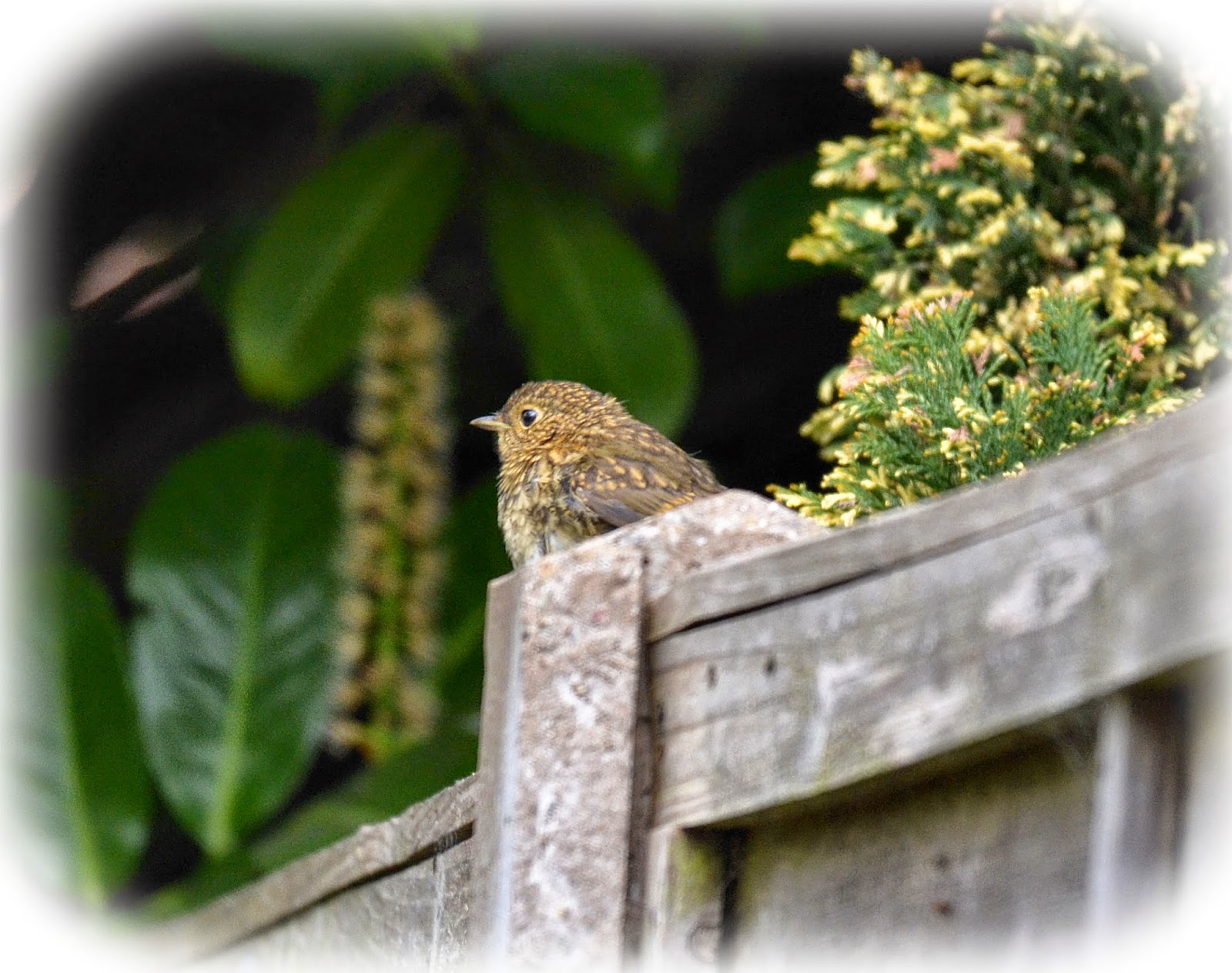
I would like to have seen my daughters faces when they read this blog post title, but yes we have a new baby, the first baby bird of the year has fledged and is now exploring the garden.

We have had a pair of Robins in the garden since christmas, I have also seen on occasion the male Robin fly to the female in the garden shrubs and feeding her with insects and morsels of fatball, a very attentive male, I believe this is all part of the pair bonding.

 This is not an unusual occurrence as the female Robin stays on the nest incubating her eggs for about two weeks, and during this time the male will bring her food.

So today, 22nd April the first Juvenile Robin has fledged from its hidden nest somewhere at the bottom of the garden, curiously only one juvenile has been seen, maybe more will follow in the next few days.

The juvenile Robin does not get its red breast for about two months after fledging, this prevents it from being attacked by the parent birds as an intruder, Robins are very territorial.
The shape of the juvenile is quite unmistakable though.

My first glimpse was this morning when I heard the juvenile begging for food on the fence, and then mostly hidden views as the parent birds took food to the fledgling hidden within the shrubs.


I kept an eye on the birds throughout the day while I tinkered around in the garden, eventually when the parent bird was collecting food on the lawn, the fledgling flew out of its sheltered position and begged for food, allowing me to get a nice photograph to record the occasion.


Robin

More new arrivals should be on the scene soon.
.

Monday, 20 April 2015

Foul play !!!


I am always excited when a new bird appears in the garden, and a few weeks ago while working in the garden a Grey Heron flew low over the gardens, we are not talking country houses here, this is suburbia, I remember thinking to myself that Heron has entered my 'air space' I  can claim that  for my garden bird list.

A few days later, early in the morning, as I glanced out of my bathroom window, there was the Heron sitting on the ridge of my neighbors garage, our eyes met for the briefest of moments, before he silently lifted off and disappeared from sight, again I thought to myself, I am definitely claiming that for the garden list.
A few more days past, and glancing at my pond, I thought that's strange I haven't seen my prized Goldfish swimming around lately, on closer inspection I found two of my fish cowering within the weed of the pond, three other Goldfish had disappeared, and these are not small Goldfish, and I am very attached to these fish as my family will vouch, especially after the ups and downs of Goldfish care we have shared together over the last few years.

Then it dawned on me that Heron has been back a few more times than I have realized.

Okay so maybe not this individual, but in my minds eye, this is how I imagine him, standing on the edge of my very modest pond, with the look of the "Angel of Death", my admiration for this species is fast fading.


What's really annoying me also, apart from the fact of losing my prized goldfish, is that I purchased a very nice decoy heron, not a cheap plastic heron  but a realistic ornamental heron which has stood guard over my pond for the last few years. I was under the impression that a Heron would not come down to a pond where another Heron was feeding, How wrong was I.

In a surreal conversation with the fish keeper of the local garden centre, we discussed the loss of my goldfish to the Heron,  I mentioned the fact that  I had a decoy Heron in position  on my pond, and I was surprised that another Heron had come down to the pond.

"Well does it move around then" he remarked, I thought obviously not its ornamental,  he was being sympathetic, so I kept my thoughts to myself.
According to the fish keeper herons are very clever birds, not only do they memorize where all the ponds are in a local area, they can detect whether a decoy is real or not, the trick is to keep changing the position of the Heron, or I could invest in there latest laser triggered heron scarer at a cost of £140.00, I thanked him and said I would move the decoy Heron around.

I am now locked in a crazy battle like the reality programme " Bad Neighbors" each night  I go out to the pond to change the position, I find myself waking up early in the morning because I think the Heron is about to take my last fish.

Today the Heron blatantly landed on the garage roof at 14.30 hrs in the afternoon, I was alerted  by the manic screams of my wife to this fact, "the Heron, the Heron"

Maybe I should accept the inevitable, .... but I can't , this battle will continue.............


Friday, 3 April 2015

Oak & Nuthatch !

My local patch Ashenbank Woods has been providing me with some good woodland photographic opportunities as well as enhancing my knowledge and understanding of  woodland natural history.
I thought I would write a more in depth report on the Nuthatch nest site

I made an effort to learn a few calls from the woodland birds that  I might come across, the call of the Nuthatch was one of those, nothing special about that,  its quite an easy call to recognise, but it makes locating the Nuthatch a lot easier.


I have been trying for sometime to get a decent photograph of a Nuthatch, without much success, my luck  may have changed as I have stumbled across an active nesting sight, so if all goes well for the Nuthatches, the opportunity to study their nesting activities and the chance to get some photographs will be very welcome.

So this  is the Oak tree, the Nuthatches are nesting in what looks like an Oak Burl, approximately ten metre above the ground, indicated by the white star in the photograph


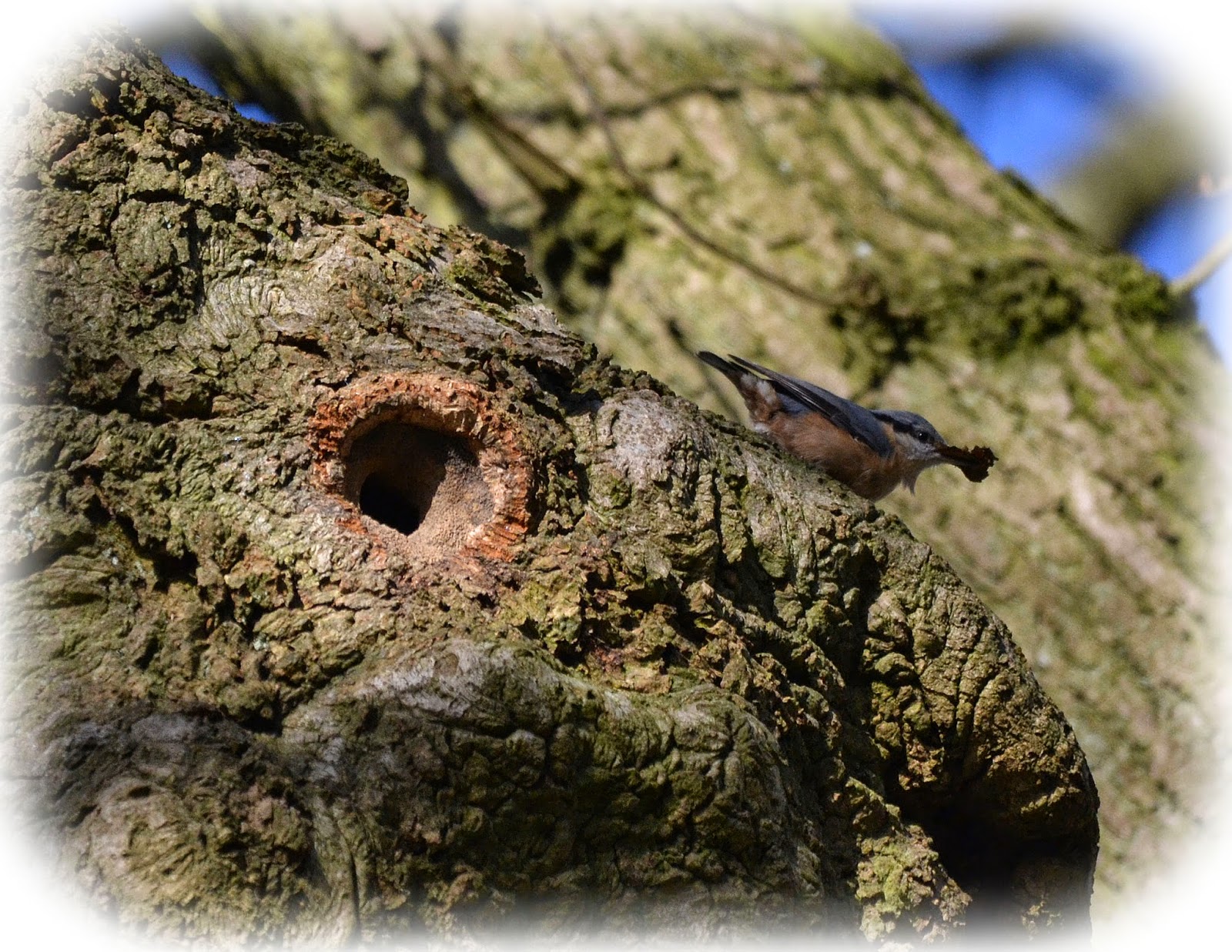
This is a close up of the Oak burl and the entrance to the nesting burrow, it looks like the bark has been chipped away all around the entrance, the actual entrance hole looks quite small, Nuthatches are known to reduce the size of entrance holes by plastering around the hole with mud, the optimum being about three centimetres .


I found this line drawing of various Nuthatch nesting burrows to give an idea of what's going on inside.


I first came across this site on 1st April , two birds were coming to the nest site, very difficult to tell which bird was male or female, I believe the only way to tell is the underwing colouring, which in the male is slightly darker orange , the female is lighter and more uniform, I have found this not to be very helpful in the field. The photograph below does show a slightly darker brick red to the underwing, so could this be the male ?

Possible male Nuthatch ( darker brick red underwing )


Both birds were seen arriving at the nest site with bark flakes in their beaks, which they quickly deposited within the burrow before quickly exiting. see photographs below and the diagram above.
It seems that the depth of the burrow can be controlled by the depth of the bark flake level, ensuring the optimum level is obtained, the eggs are laid in a shallow depression within the bark flakes.


Possible female nuthatch ( paler underwing blending into breast)
So it appears that three days later April 3rd, both birds are still bringing in bark flakes for the interior of the burrow. It will be difficult to know whether eggs have been laid if it gets that far, I suppose seeing the  parent birds bringing food to the burrow will indicate successful hatching. I will be keeping a watchful eye as I pass through on my daily walk through the woodland, a further report to follow as things hopefully progress.