Saturday, 13 June 2015

A Session with the Bee's !

I have been trying to naturalise our garden as much as I can, I have collected and strategically placed dead wood branches around the pond, birds are already using these to make there way down to the artificial waterfall where they can drink and bathe, Robins, House Sparrows and Blackbirds seem particularly fond of bathing and drinking here, rather than the bird baths.


The dead wood branches around the feeding station  allow the birds to fly in and perch (pose) before moving on to the feeders, I have been keeping an eye on these new perches which now seem to have been accepted and are being used by House Sparrows, Goldfinch, Greenfinch, Chaffinch, Blue tit, Great Tit, Dunnock Robin and Blackbirds so far, this should make for  some more interesting photographs, rather than on the actual feeders which do not look so good in photographs.


The Buddleia tree I planted last year has grown nicely and I am looking forward to it flowering in the hope that more Butterflies are drawn into the garden, at the moment Holly Blue's are seen most frequent, probably because of the Ivy we have growing on an adjoining brick wall. Occasional visits by Peacock, Red Admiral, Brimstone, Small White, Large White, hopefully these will become more regular when the Buddleia flowers.

My new shady area flower bed under the pear tree, up until recently an area where nothing really grew, looking much better now. complete with genuine pear tree logs, and some nice ferns,  I am hoping these may attract some insect life.


The Flowering Blackcurrants around the garden are a fantastic pollen source for the bees and Bumblebee's from March and April but once these drop their flowers the Bee sightings become less frequent.

 A new shrub called "Libertia grandiflora" that's been flowering from mid May and is still in flower now in mid June, maybe the answer, its providing an excellent pollen source for the Bee's and drawing them back into the garden.
The shrub is a native plant of New Zealand, I first noticed it after a trip to Kew Gardens, I must admit you do not see many for sale in the garden centres, I had to order mine from the internet, its certainly worth looking for, as the Bee's seem to love it.


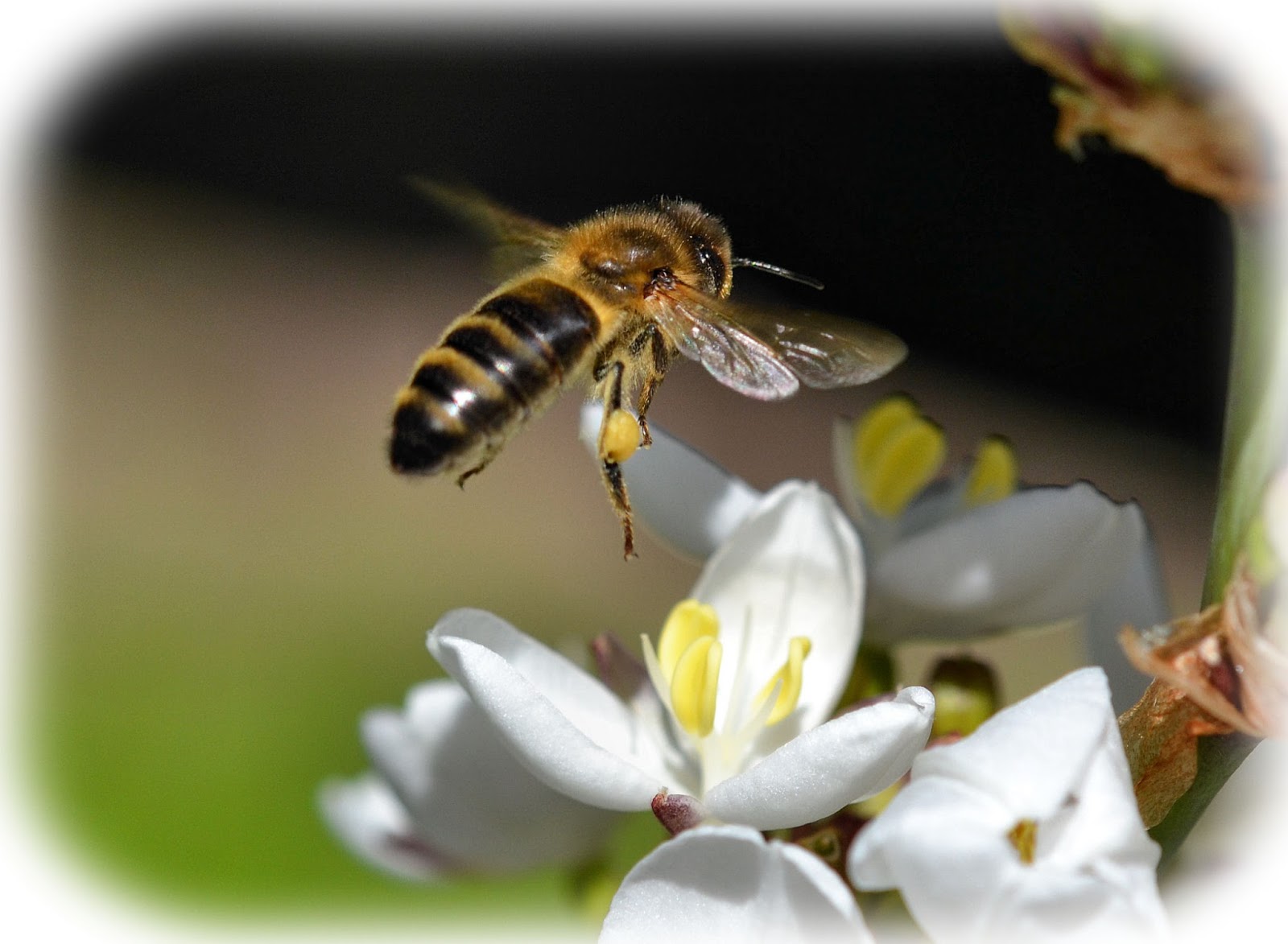
On a particularly sunny afternoon recently, I noticed  the Libertia was covered in Bee's, the opportunity to get some close up shots was too great to pass up, they seemed unconcerned by my presence, spending a short time on each flower before moving to another.

The majority of the bee's appeared to be Honeybees, to be more precise, the Western Honeybee or European Honeybee (Apis mellifera) , although to be honest there seemed to be a lot of variation in appearance, some of the Bee's were quite hairy on the abdomen  while others had lost the hair on some of the abdomen segments showing orange stripes, hopefully I have got the right identification.

European Honeybee (Apis mellifera)   'worker'


A few other Bee's were seen on the same shrub, heres a couple of shots of a Carder Bee, with its tongue sheath extended

Carder Bee


A few of the smaller Bumblebee's were also taking their share of the pollen, These are Early Bumblebee's Bombus pratorum


Early Bumblebee worker  Bombus pratorum


Early Bumblebee Bombus pratorum  male

This very nice Marmalade Hoverfly was in amongst the Honey Bee's together with another stranger to the garden, 

Episyrphus balteatus  Marmalade hoverfly

This one proved harder to identify, my first thoughts was some species of Hoverfly, but eventually identified as a Tapered Drone fly. Its a type of Bee mimic very similar to a Drone fly.

Sometimes, If you take the time to look a bit closer at those insects buzzing around your flowers you will be amazed at the different varieties visiting.

Monday, 8 June 2015

Short break in Yorkshire !

The 'Buyagift' short break, that our daughter and son in law had gifted us with, was finally put to good use with a trip to the East Riding of Yorkshire and a stay in the lovely market town of Beverley.
 We made our way up the A1 towards the North,  a mobile phone call from our Yorkshire daughter en-route, informed us that it was  raining hard up there, I glanced out the car window to look at the brilliant blue sky and sunshine we were leaving behind.
But we needn't have worried, as we arrived in Beverley the sun was shining, we were ready for a nice evening walk. I tentatively suggested a walk along Bempton cliffs, which was only a short drive away to which my wife agreed.


Fortunately for me, this is also one of England's top seabird sites, there was some fantastic views of seabirds all along the  clifftop, together with some stunning views along the coast line towards Flamborough Head.


Gannet 
Gannets
Possibly not the best of neighbours, but we all need our space.

Gannet and Guillemots 

One of the birds everyone wants to see is the Puffin, to be honest these were in short supply we only saw one Puffin before it left the cliffs  for the sea.

Puffin & Razorbill

Razorbills and guillemots were very abundant occupying  every suitable ledge on the cliff face.

Guillemots
Razorbill


Kittiwakes seemed to be the other common seabird here, a few Fulmars and a few large gulls patrolling the cliff edges.

Kittiwakes
Fulmar
As we walked along the cliff tops enjoying the views and the air, we were pleasantly surprised to see not one, but two Barn Owls, one even joining the seabirds on the cliff top, very surreal.

Barn Owl on Bempton Cliffs


The Tree Sparrow colony at Bempton cliff RSPB visitor centre is still thriving, I do not get to see many of these apart from a colony at Dungeness RSPB.


Tree Sparrow
 We planned to visit Whitby today with a short diversion to Blacktoft RSPB near the town of Goole, there had been reports of  a pair of Montagu's Harrier breeding there, which would have been nice to see, no such luck, plenty of Marsh Harriers on view, the RSPB voluntary wardens suggested at least a three hour wait to see them, I could not inflict that on my very patient wife.

Marsh Harrier at Blacktoft Sands RSPB.
On to Whitby near the Yorkshire Moors for some sight seeing, a very nice old fashioned seaside resort, with a 'Dracula' fixation.

Whitby


Abbey ruins on east cliff of Whitby

This old tourist tour bus caught my eye, you'll notice on the front radiator the company name of 'Dennis', this was also the make of the first Fire engine I rode in when I joined the Fire Brigade back in the 1980s, complete with wheeled escape ladder on the back. 'good old days'

No trip to Yorkshire is complete without a walk on the Yorkshire Moors, we plumped for a walk across the moors via Horcum Hole, very nice walk, Meadow Pipits, skylarks very common, Common Redstart seen as we came back through Horcum Hole.


Very nice county to visit, beautiful scenery, lovely towns and resorts.


Monday, 1 June 2015

Feed me, feed me !!!


Its that time of year again, when the garden around the pear tree is alive with juvenile birds.
 So here's a look at what's happening around the garden for this month.

The Blackbird family has managed to raise three healthy youngsters despite the continual attentions of the local Magpies, which also attempted to nest close by, too close for the Blackbirds liking, the male Blackbirds alarm call has been manic at times, but I must admit to a soft spot for this pair, the male has been courageous in his efforts to protect his territory, most occasions, a ferocious dive at high speed has been sufficient from the male to drive them away, on one occasion I witnessed the Magpie investigating a conifer tree in my neighbor's garden, being preoccupied he didn't notice the Male Blackbird launch his attack, amazingly it appeared to crash into the Magpies back, pulling it out of the tree  and down to the ground, there followed some indignant squawking, the Magpie left the scene at speed, the male Blackbird returned to his lookout high in the pear tree.

Most days the Blackbirds can be found skulking around the borders, running around the lawn under the feeders and grabbing tit-bits that fall, just lately the male Blackbird has taken to hovering, albeit for a short moment in front of the feeder,grabbing a bite from the fat balls in the feeder.

Male Blackbird

The female has developed a slightly different technique.

Female Blackbird


The Juvenile Starlings are so intent on begging for food that they sometimes get confused, I witnessed a Starling making the mistake of trying to steal a meal from the Blackbird, once again aggressively chased away.

The garden is looking more like a creche for juvenile birds at the moment, as well as the Blackbirds the raucous cries from the Starlings begging for food seem constant throughout the day.

Love them or hate them Starlings are always there in the garden, and very watchable, the sexes appear to look very similar, I did read somewhere that in the breeding season their is a slight variation in the colours at the base of the beak, blue  for males, pink for females, sounds familiar,

The photograph below demonstrates this quite well, the two Starlings at the top of the feeder have a blue base to their beak, and should be males. The Starling at the bottom has a pink base to her beak and should be the female.

Male & female Starlings
Starlings have nested in my neighbours eaves again this year, heres a few photographs of the Starling Family, before they left the safety of their nest site.


These have now left the nest and joined the throng of other juveniles screaming for food from every available vantage point.


And a final look at a mature Starling with the sun bringing out the iridescent colours within the feathers.


The Robin pair have already raised one brood this year, I noticed the male Robin has been feeding the female again, part of the bond strengthening process, maybe getting ready for a second brood.

Robin pair
House sparrows have suddenly reappeared in the garden after a short absence, bringing with them their young families, the adults flying from the trees with a train of juveniles following behind. They then sit around the feeders fluttering there wings and demanding food. Most of the feeding appeared to be by the female sparrows , although I have seen a male sparrow feeding on one occasion.
Heres a selection of House Sparrow photographs taken over the last few days.

House sparrow family


Other birds visiting the garden have included this fine Great Spotted Woodpecker that appeared on the garden feeder after a long absence.

Great Spotted woodpecker

Ring necked Parakeets are still visiting the pear tree, usually early morning and early evening.

Ring-Necked parakeet

Greenfinches are becoming more regular now that they have discovered the sunflower heart source.
Goldfinches are here every day and becoming more tolerant of  human presence around the garden.

Goldfinch
Chaffinches have become scarcer as we move away from the winter months, an occasional male has been seen on the feeders.

Chaffinch
Blue Tits are regular visitors, I have only noticed one juvenile , and only because of the wing fluttering and demand for food.

Blue tit

Great Tits are also regular visitors  but they do not seem to linger ,
 a quick snatch from the feeder and they fly off.

Magpie

One of the Magpies before it was seen off by the Blackbird.

and finally, no further visits from the Heron