Friday, 31 July 2015

Wildlife in the garden

I thought I would put together some photographs and observations of the wildlife seen in the garden over the last few weeks of summer.

My deadwood perches that were strategically placed around the feeders seem to have been accepted by the local garden birds, many of them flying in and perching on these branches before moving on to the feeders, I have also noticed that many of the birds use these branches to clean their beaks, swiping them to and fro before moving on.

One of my favourite birds of the garden at the moment has to be the Robins that have set up a territory close by, now re-established as the country's favourite and national bird,  and I am not sure why we needed to have a re-vote, I thought the Robin always was the country's national bird, this dating back to the 1940s, maybe unofficially though.


 I have often listened to those stories, usually told by old gardeners, of the Robin that sits on the garden fork while the flower beds are dug over, like an old friend.

Well I have an old friend now, these last few months I have often had that feeling that I was being watched, especially when digging around in the garden, often as I have looked up, there it is, sitting on a branch very close by, sometimes unusually close by, he makes a quick grab of an unseen morsel and flies off.
I don't know where they are nesting, but two broods have been successfully reared this year, the occasional sighting of a juvenile skulking around under the garden shrubs have been seen.

Juvenile Robin
I love watching the male court the female, re-establishing their pair bond, often taking sunflower hearts from the feeders and flying to the female offering the food.

 The most unusual and surprising event was watching the male Robin flying around the garden with a very large green caterpillar in its beak, he tried to offer it to the female, she seemed uninterested, as he flew from branch to branch with his prize, a Great Tit flew down beside him, snatched the caterpillar from his beak and flew off with it, the Robin just sat there. Its passiveness was quite surprising when you take into account its aggressiveness shown to any rivals that enter their territories

Robin pair bonding
Intimate moment captured
This Wren was a very unusual visitor to the garden, I caught sight of something moving through the ivy at the back of the pond, which finally revealed itself to be a juvenile Wren, soon disappeared again.

Juvenile Wren


 A few days later I saw this adult Wren taking a drink from the bird bath, maybe they nested close by.

Wren
The House Sparrows seemed to have had a good breeding season this year, the number of broods visiting the garden and the feeders, certainly belies the reported decline in their numbers.
A pair of Hedge Sparrows or Dunnocks as they are now called seen occasionally.
 Heres some of my favorite photographs.

House Sparrow


Hedge Sparrow or Dunnock


Plenty of Finches still visiting the garden, Goldfinch, Greenfinch and Chaffinch, the Greenfinches appear to have overcome their initial shyness and happily feed in my company.

Chaffinch
Greenfinch
Juvenile Greenfinch

Goldfinch


Great Tits are coming to the garden feeders as regularly as the Blue Tits, they too, seem to have overcome their initial wariness.

Blue Tit juvenile
Great Tit Juvenile
Ring -Necked Parakeets are now feasting on my pears.


Other birds noted have included the regular Collared Doves, Wood Pigeons which are now nesting in the Wisteria over the front entrance door, the occasional Magpie, the Blackbirds and Starlings.
The Sparrowhawk has reappeared and has made at least three attempts that I have witnessed to snatch a meal from the pear tree, so far unsuccessfully 

Friday, 3 July 2015

Another Stag Encounter !!

It was about this time last year, when I was fortunate enough to be able to photograph and study a very nice male Greater Stag beetle, an unwelcome guest at an evening party.

The weather has been very humid and sultry these last few days, perfect Stag Beetle weather,
 My evening walk with my dog takes me past a very busy roundabout, lots of pedestrian traffic lights, lamp posts and neon signs from the local Sainsbury's superstore, surrounded by trees

I am pretty sure that a few years ago, while watching one of those Attenborough wildlife programmes, in which they concentrated on a similar looking beetle called the Rhinoceros beetle or Dynastinae, they spoke about its attraction to bright lights, as it flew on one of those hot humid evenings in search for a female.

May be coincidence, but the last few days I have encountered a male Greater Stag with some pretty impressive mandibles, this was making its way off the traffic island towards the road, lots of bright flashing lights, a quick rescue was put into place and a release in the safety of the wood pile in the garden, Still there in the morning so a few more photographs were taken, a few hours later and it had disappeared.

The next night a female Greater stag was seen, making its way along the gutter of the road, another rescue, this time released into some nearby tree's.


Greater Stag beetle (Lucanus cervus)


Always impressive when you meet one of these little beauties !.

Saturday, 27 June 2015

Tale of two trips !


 I would like to say that my three daughters have inherited my love of all things wild and natural, they should, they spent a good part of the growing up traipsing around the countryside and enjoying it, or so I thought, but sadly the answer is no.
 My middle daughters love of nature extends only to her two black cats, my son in law has embarked on a deforestation plan in their garden, their Hedgehog  has had to find a new home.
 My youngest daughter flatly refuses to share a room with any creature that vaguely resembles a spider, and lives in a concrete jungle.
 My eldest daughter is interested in photography, not necessarily wildlife photography, she has amazingly, retained some of her bird identification skills, but strangely, hates my dog.
 My wife gets hysterical at the sight of my garden pond inhabitants, (frogs), especially if at any time their paths do cross ..............life can be difficult at times.

 So on this 'Father's day' weekend, my eldest daughter was visiting from York and suggested a photography trip out into the country, my middle daughter and Son in law decided to restock my pond with some very nice Koi fish, my youngest decided to grace us with her presence.
Things were looking up.

Time was relatively short so I suggested Rainham RSPB, just a short drive away.

She had never visited an urban wildlife site before, I think she was pleasantly surprised by the habitat and photography opportunities that arose.

The weather was not brilliant, in fact we had some drizzly rain, but we still managed some good sightings.

I went back a few days later alone,when the sun was shining, so this is a compilation of sightings from the two short trips.

Our first stop off was the MDZ area , a short walk along the boardwalk, there has been  reports that the Kingfishers had been clearing out their nesting tunnel after the successful fledging of their first brood, and maybe a second brood was in the oft.
The Hide was empty on our arrival, not a good sign, we decided to give it five minutes to see if any Kingfishers were around. My daughter has never seen a Kingfisher up close and personal, unbelievably, within about thirty seconds the female Kingfisher flew into the pool and landed on one of the perches, it stayed on the perch for at least ten minutes or so. occassionaly preening, a few photographs were taken needless to say, always a bit hazy through the glass of the hide screen, my daughter was pleased with the sighting, things were looking up.

Female Kingfisher
My second trip did not produce a Kingfisher, but a reed Warbler posed nicely on one of the dragonfly sculptures, and a very nice female Four Spotted Chaser posed briefly on a reed stem.

Reed warbler
Female Four Spotted Chaser

We moved on down the boardwalk, checking out the reed fringed dykes for a Water Vole sighting, she was unlucky on her visit, but I did manage a brief view of a Water Vole as it swam across the dyke before disappearing into the reeds.

Water Vole
Plenty of Coots and Moorhens, some with families, some nesting again for a second brood.

Coot family
Moorhen on nest
A Grey Heron posed nicely for us on one of the bridges, on my second trip I watched a Heron flying low, surprising a Coot family on the edge of the reedbed, without landing it reached down and snatched a young coot with its beak and continued flying with the baby coot dangling from its beak, 
I don't think she would of liked that view, nature can be very cruel at times.

Grey Heron


The Marsh Frogs were very vocal, my daughter was fascinated by them and snapped away when ever she saw one, this was my attempt on the second trip, a particular photograph I have been trying to get. I watched this frog for some time, He could hear other male frogs calling in the distance, he was making his way towards them, stopping every  few feet to pump up his air sacs and call, on each call the air sacs would get bigger, until he decided to move off,when they deflated

Marsh Frog calling

We moved on to the dragonfly pools, I casually said that there had been sightings of Bearded Tits in the area, another bird she had not previously seen, unbelievably again a family of Bearded Tits flew in next to us , totally unconcerned by our presence, difficult to photograph in the reeds though.

Bearded Tit juvenile


Just past the Dragonfly pools and the loud call of a Cetti's warbler was heard , and then briefly the Warbler showed itself on some Hogweed, called again and disappeared

Cetti's Warbler.
On my daughters visit the drizzly rain kept the dragonflies away, not so on my second visit, the Black Tailed Skimmers were flying around the pools occasionally landing on the timber boardwalk.

Black Tailed Skimmer
Other dragonflies on show was this female Ruddy Darter, quite a few Emperor Dragonflies were patrolling up and down the dykes, A few Azure and Blue Tailed Damselflies were resting on the reeds and just one Banded Demoiselle.

Ruddy Darter female
Continuing the walk around the reserve alongside the eurotunnel railway this Flowering rush caught my eye, a very attractive reed bed plant

Flowering Rush
Good numbers of the not so rare Little Egret scattered around the marshes


Plenty of Butterflies on show, Meadow Brown, Small Tortoiseshell, Holly Blues, Small Skipper, Essex Skipper and a nice Cinnabar moth.

Small Tortoiseshell
Small Skipper
Essex Skipper ( black tips to antenna)
Cinnabar moth
I always get these initially confused with spotted Burnets, but the Cinnabar clearly has that straight bar along its wing, should make ID easier in the future for me.

Caterpillar of the Drinker Moth
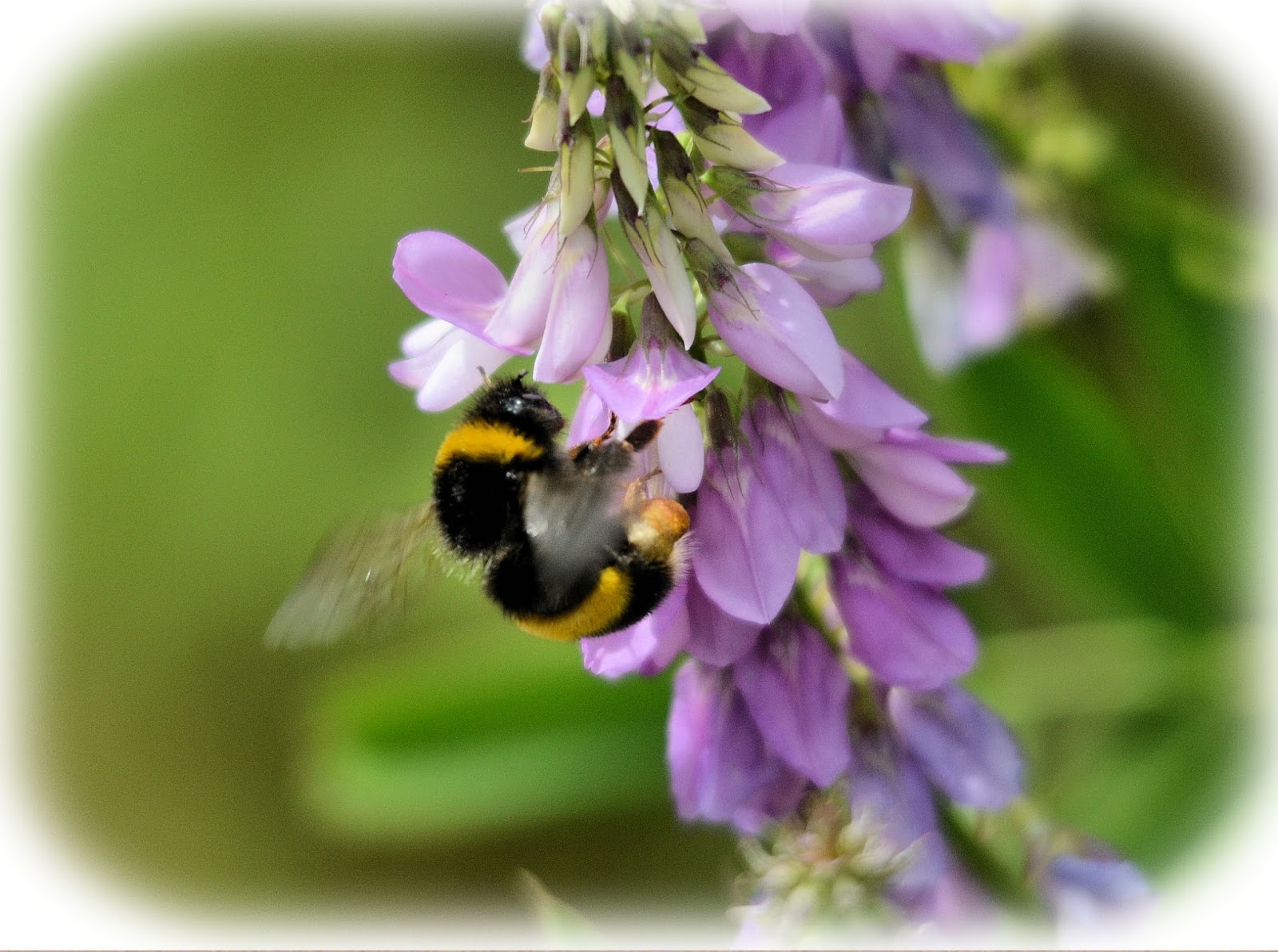
White Tailed Bumblebee
Lots of White Tailed Bumblebees feeding on the vetch around the reserve.

Lots of photo opportunities around the reserve, always worth a visit.

Saturday, 13 June 2015

A Session with the Bee's !

I have been trying to naturalise our garden as much as I can, I have collected and strategically placed dead wood branches around the pond, birds are already using these to make there way down to the artificial waterfall where they can drink and bathe, Robins, House Sparrows and Blackbirds seem particularly fond of bathing and drinking here, rather than the bird baths.


The dead wood branches around the feeding station  allow the birds to fly in and perch (pose) before moving on to the feeders, I have been keeping an eye on these new perches which now seem to have been accepted and are being used by House Sparrows, Goldfinch, Greenfinch, Chaffinch, Blue tit, Great Tit, Dunnock Robin and Blackbirds so far, this should make for  some more interesting photographs, rather than on the actual feeders which do not look so good in photographs.


The Buddleia tree I planted last year has grown nicely and I am looking forward to it flowering in the hope that more Butterflies are drawn into the garden, at the moment Holly Blue's are seen most frequent, probably because of the Ivy we have growing on an adjoining brick wall. Occasional visits by Peacock, Red Admiral, Brimstone, Small White, Large White, hopefully these will become more regular when the Buddleia flowers.

My new shady area flower bed under the pear tree, up until recently an area where nothing really grew, looking much better now. complete with genuine pear tree logs, and some nice ferns,  I am hoping these may attract some insect life.


The Flowering Blackcurrants around the garden are a fantastic pollen source for the bees and Bumblebee's from March and April but once these drop their flowers the Bee sightings become less frequent.

 A new shrub called "Libertia grandiflora" that's been flowering from mid May and is still in flower now in mid June, maybe the answer, its providing an excellent pollen source for the Bee's and drawing them back into the garden.
The shrub is a native plant of New Zealand, I first noticed it after a trip to Kew Gardens, I must admit you do not see many for sale in the garden centres, I had to order mine from the internet, its certainly worth looking for, as the Bee's seem to love it.


On a particularly sunny afternoon recently, I noticed  the Libertia was covered in Bee's, the opportunity to get some close up shots was too great to pass up, they seemed unconcerned by my presence, spending a short time on each flower before moving to another.

The majority of the bee's appeared to be Honeybees, to be more precise, the Western Honeybee or European Honeybee (Apis mellifera) , although to be honest there seemed to be a lot of variation in appearance, some of the Bee's were quite hairy on the abdomen  while others had lost the hair on some of the abdomen segments showing orange stripes, hopefully I have got the right identification.
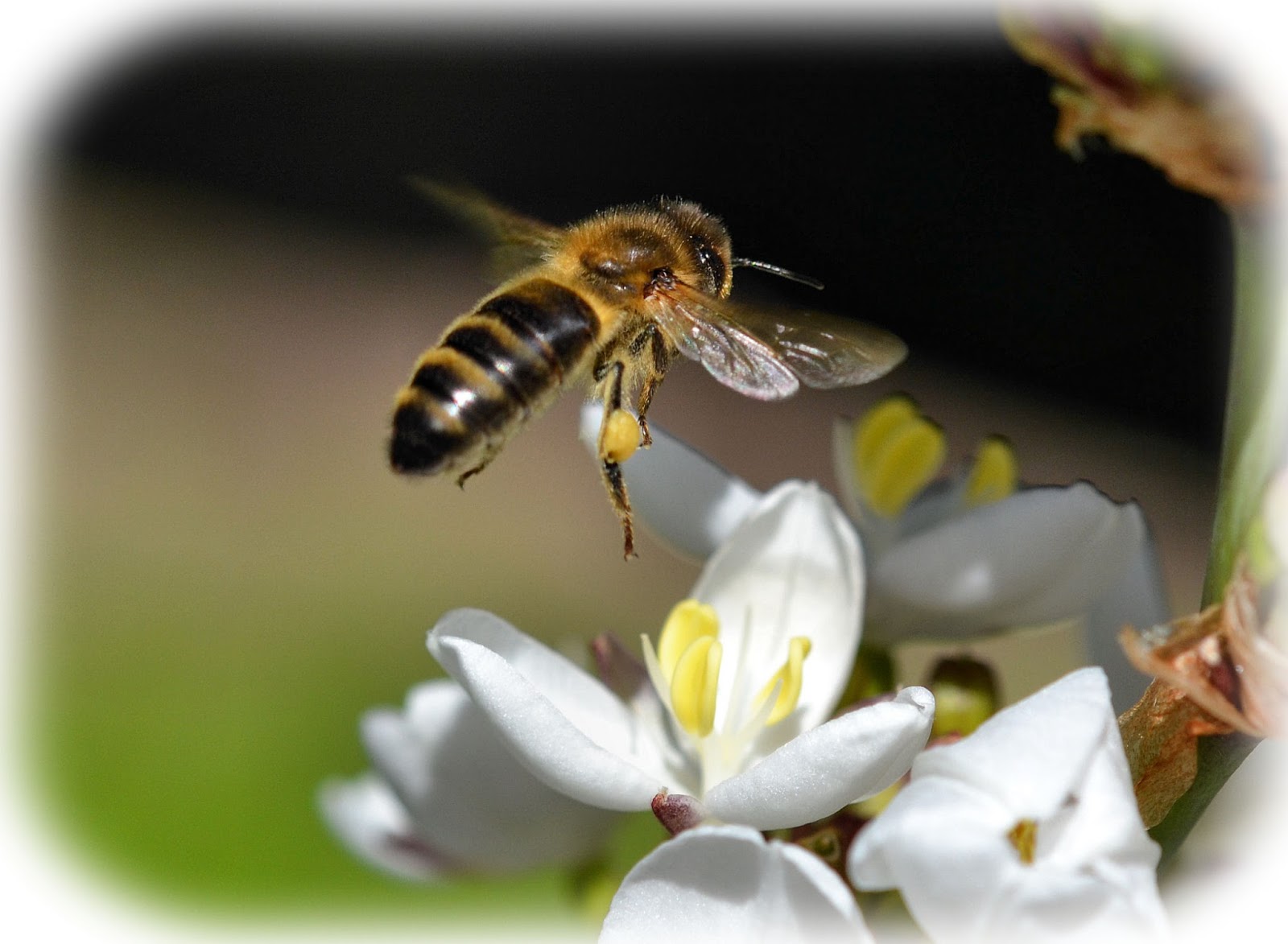
European Honeybee (Apis mellifera)   'worker'


A few other Bee's were seen on the same shrub, heres a couple of shots of a Carder Bee, with its tongue sheath extended

Carder Bee


A few of the smaller Bumblebee's were also taking their share of the pollen, These are Early Bumblebee's Bombus pratorum


Early Bumblebee worker  Bombus pratorum


Early Bumblebee Bombus pratorum  male

This very nice Marmalade Hoverfly was in amongst the Honey Bee's together with another stranger to the garden, 

Episyrphus balteatus  Marmalade hoverfly

This one proved harder to identify, my first thoughts was some species of Hoverfly, but eventually identified as a Tapered Drone fly. Its a type of Bee mimic very similar to a Drone fly.

Sometimes, If you take the time to look a bit closer at those insects buzzing around your flowers you will be amazed at the different varieties visiting.