Wednesday, 8 February 2017

" Woodies " in the Ivy !


It always surprises me when I glance out of the window, and I am confronted with four or five pigeons hanging from the Ivy and I do mean hanging from the Ivy its amazing the positions they get themselves in for such a large cumbersome Pigeon.


These Ivy berries first appear back in November of the previous year, but the birds do not eat them until now, although loved by a few species of birds I have only witnessed the Wood Pigeons, Blackbirds and the occasional Blackcap eating the berries, Thrushes such as the Redwing, Mistle Thrush and Song Thrush also like them but are rarely seen in the garden these days.


Female Blackcap

Wren in the Ivy


Blackbird from last winter


According to the RSPB these Ivy berries contain nearly as many calories as a "Mars Bar" gram for gram and explains why they are so popular, when at the end of winter food sources are running low.
Not so good for the human palette, all parts of the plant are toxic to humans, the berries are poisonous but because the berries are so bitter to taste, its rare for a person to ingest enough to become poisoned.

( The berries contain oxalates, needle-like crystals that cause pain and swelling in the lips, face, tongue, and skin.)


Its amazing how wildlife friendly a patch of Ivy is, and if you have this growing in your garden you will know this to be true. Mine covers an unsightly wall next to my pond, we have had Blackbirds nesting in the thick foliage, I have seen on occasion both Wren and Goldcrest searching through the leaves for a meal during the winter months.


It flowers in the Autumn and its a magnet for Bees, hoverflies and all manner of other insects. The Ivy Bee Colletes hederae  feeds exclusively on its flowers  and I am fortunate to see these in good numbers.

Ivy Bee's on Ivy flowers late summer
Holly Blue Butterfly seem also attracted to the ivy, a bit of research revealed that the Holly blue lays its second generation eggs in the summer on the Ivy for its caterpillars to feast on.

I am pretty sure that theirs a few  Red Admiral hibernating in there somewhere.

Moths are not to be left out, the caterpillars of Swallow tailed, Yellow-Barred Brindle and the Double Striped Pug all feed on Ivy leaves. I have seen the Swallow Tailed Moth in the garden, hopefully I may attract the others to my Moth trap this year.


It seems to me that Ivy in the garden is a positive for attracting wildlife,

 So eat on my fat feathered friends and enjoy.


Wednesday, 1 February 2017

"Big Garden Birdwatch"


Thought I would give the "Big Garden Birdwatch" ago this weekend, I made myself comfortable in the conservatory with a good view down the garden, coffee was made, feeders had been topped up the day before, I had high hopes for a good species list. My chosen time period was 09:30 hrs to 10:30 hours.

Unbelievably I stared at an empty garden completely devoid of birds for a good ten minutes or so, a few flyover Starlings a couple of gulls gliding over the garden.

15 mins and a single Starling approached one of the feeders closely followed by a further five giving a total of 6 Starlings, this was the most seen at any one time during the hour.

House Sparrows began to appear, a few singles, difficult to count as they made a snatch and grab raid on the feeders, the most I counted at any one time was eleven.

Another quiet period with not very much being seen, thirty minutes had passed with only two species in the garden.

A male Blackbird skulking under a tree at the bottom of the garden brought the list to three. A few more minutes passed and a group of Goldfinches landed on the pear tree with one moving down to the feeders.

A couple of Great Tit sightings but never more than one at any one time. just one Blue Tit.

 A Magpie landed briefly in the pear tree before it moved on, a single Woodpigeon flopped down on the Ivy and started to eat the ripened Ivy berries, Eight species and 15 mins to go.

 Two female Chaffinch approached the sunflower seed feeder, Three Collared Dove chased each other around the garden, difficult to work out who the unwelcome guest was.

A Robin was seen skulking around the back of the pond closely followed by a brief view of a Dunnock, a couple of minutes to go and three Ring Necked Parakeets landed on the pear tree.

The hour complete, thirteen species seen, a few absentees, the Greenfinch, Wren, Long Tailed Tit
 and Carrion Crow which has been using the Pear Tree as a lookout post recently.

Collared Dove 3
Goldfinch 4
Great Tit 1
House sparrow 11
Starling 6
Woodpigeon 1
Robin1
Chafffinch 2
Blue Tit 1
Blackbird 1
Magpie 1
Ring necked Parakeet 3
Dunnock1

A short while after completing the garden birdwatch this lovely male Great Spotted Woodpecker was seen on the Pear tree feeder. Where was he when I needed him.


male Great Spotted Woodpecker

I always assumed the same Woodpecker was visiting the feeders but Interestingly the Great Spotted Woodpecker seen a few weeks ago was a female, shown below without the red neck patch of the male.

female Great Spotted Woodpecker

Monday, 23 January 2017

Invasion of the Berry Snatchers !


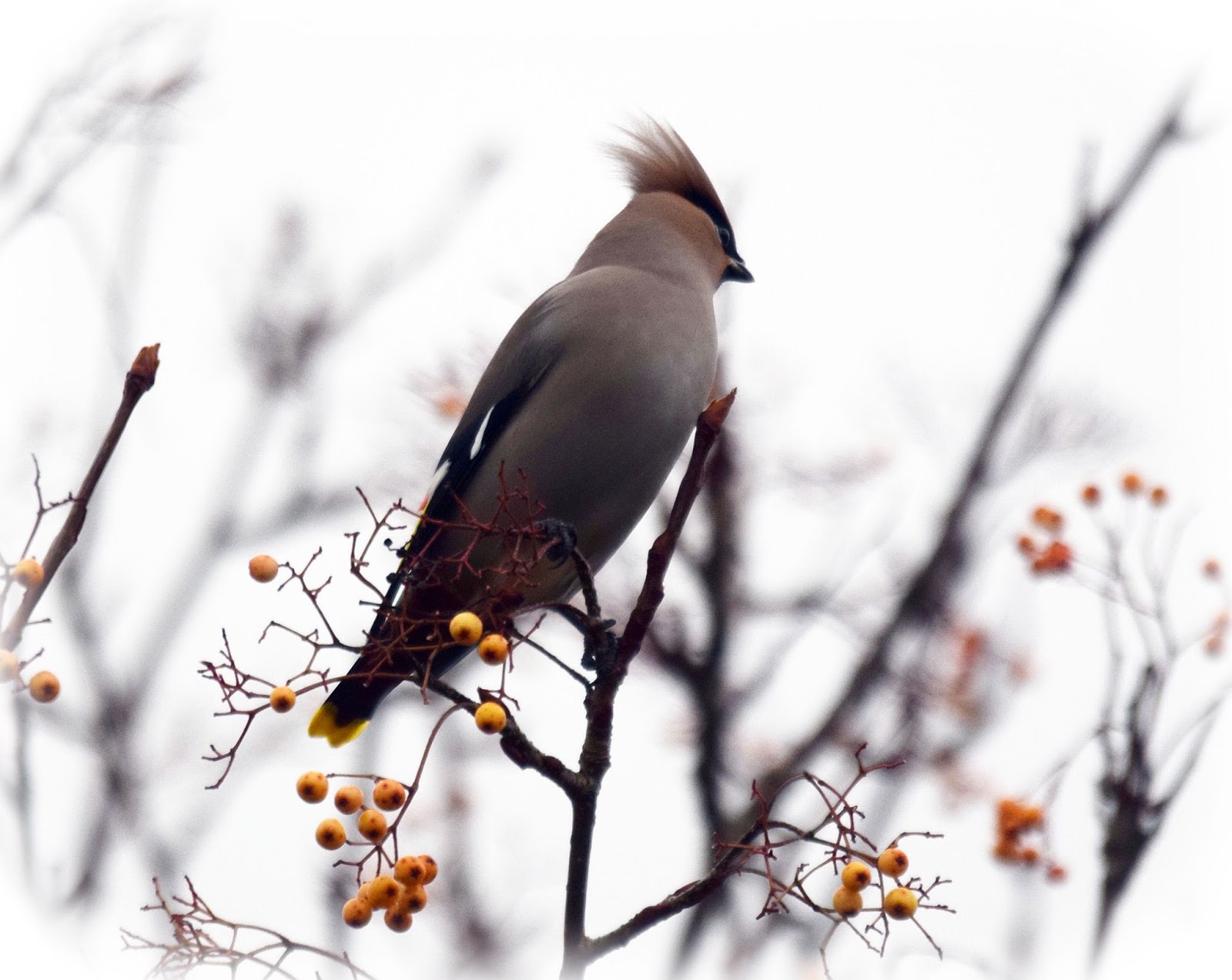
The Bohemian Waxwing, one of those 'must see' birds that visits our shores from Scandinavia each year seeking out the winter berries that our local Thrushes and Blackbirds have been relying on to get them through the cold winter months.

Early winter and reports start filtering through from Northern observers. The Waxwings have arrived, as the winter progresses, some eventually turn up down here in the south of the country.

I have heard the term 'Irruptive species' associated with the Waxwing, usally when large numbers of Waxwings arrive in the country, and this could be one of those years because there appears to be a lot of Waxwings arriving here at the moment.

I spent the early days of January visiting a small influx of Waxwings that were raiding Berry trees at Rochester at the most twelve birds, feeding on the yellow berries of some Mountain Ash trees.
I spent a few hours trying to get some photographs which I posted in the previous blog entry.

Then unbelievably, a large flock turned up at the bottom of my road, the number seems to fluctuate each day, averaging about fifty birds and at their most eighty four.

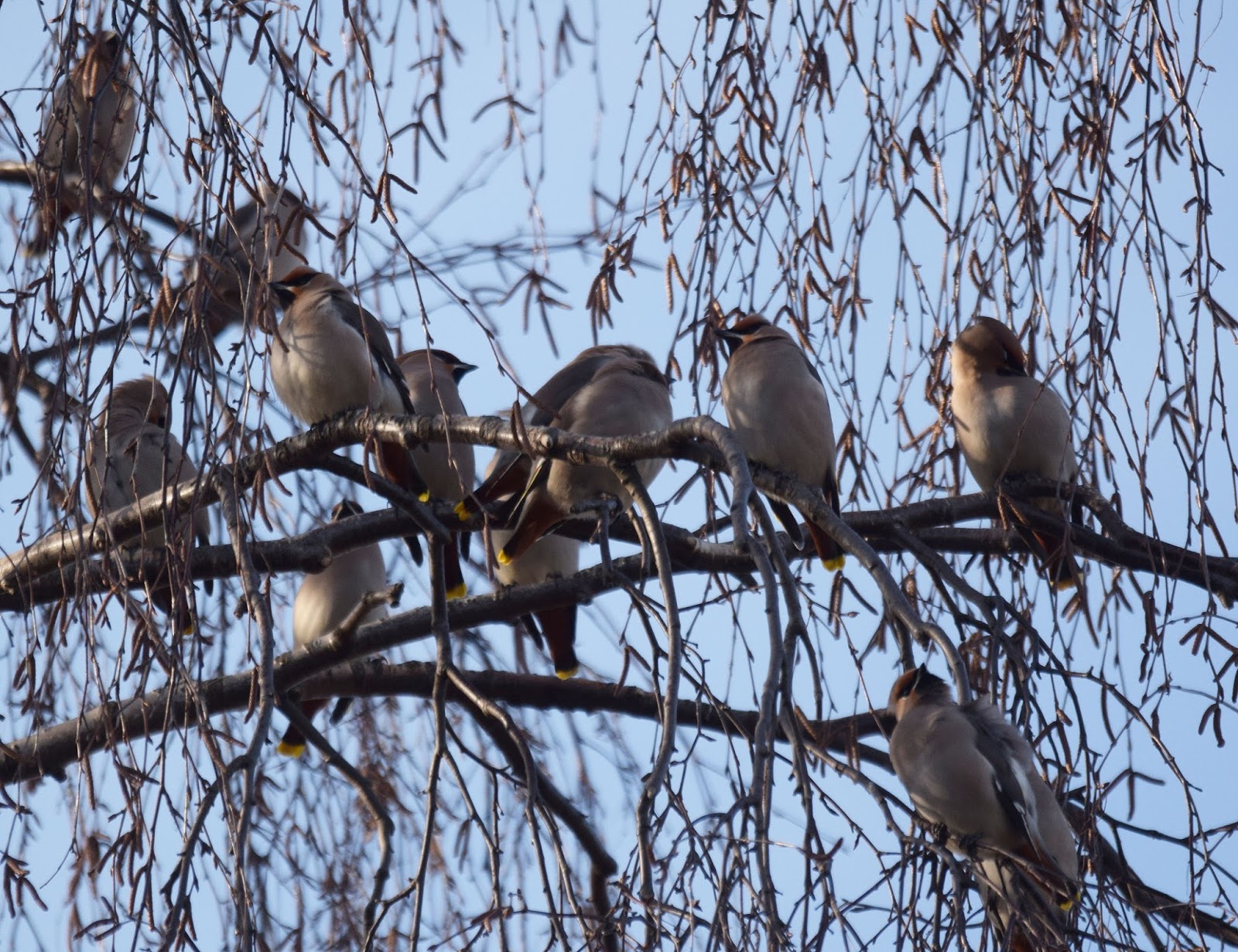
This large flock that turned up in Northfleet spent a lot of time roosting in some tall Silver Birches close to their favoured feeding area, the trees they were feeding in are very sparsely covered in berries from what I could see, but the flock has been in the area for over a week now so the berries on offer must be attractive to the Waxwings, also noticed a small flock of Redwings feeding on the same trees.

The trees they are visiting are quite spread out and the birds appear a bit flighty, the Waxwings  have a reputation for allowing a close approach, but I think the local photographers have pushed their luck a little too much.

Most of my photographs have been a little distant, but there close attendance to me is to much to resist.


I made another visit to Rochester to see if the Waxwings here were still feeding on the Mountain Ash berries opposite the Bounty pub. They were there but once again roosting in the tall trees in the pub car park, fortunately the sun was shining on them allowing a few heavily cropped photographs.


Finally to finish off my Waxwing Portfolio, I thought I would use this opportunity to record some images I took back in January 2013, another good year for Waxwings, these turned up in the grounds of the 'Holiday Inn' at Dartford in Kent.


I don't think I will ever tire of watching these beautiful birds, I will look forward to next year, hopefully they will reach us here in the south again.


Wednesday, 11 January 2017

Waxwings at Last !!!


At last the Waxwings have finally found their way down south and appearing in good numbers at some sights.
I have been teased by the appearance of just three Waxwings which turned up here in Kent at Rochester just before christmas, twice I went looking, but to no avail, very frustrating as it's been a few years since last they visited here in any great numbers.


After a short absence they have reappeared in early January with a few more of their brethren, now numbering ten.

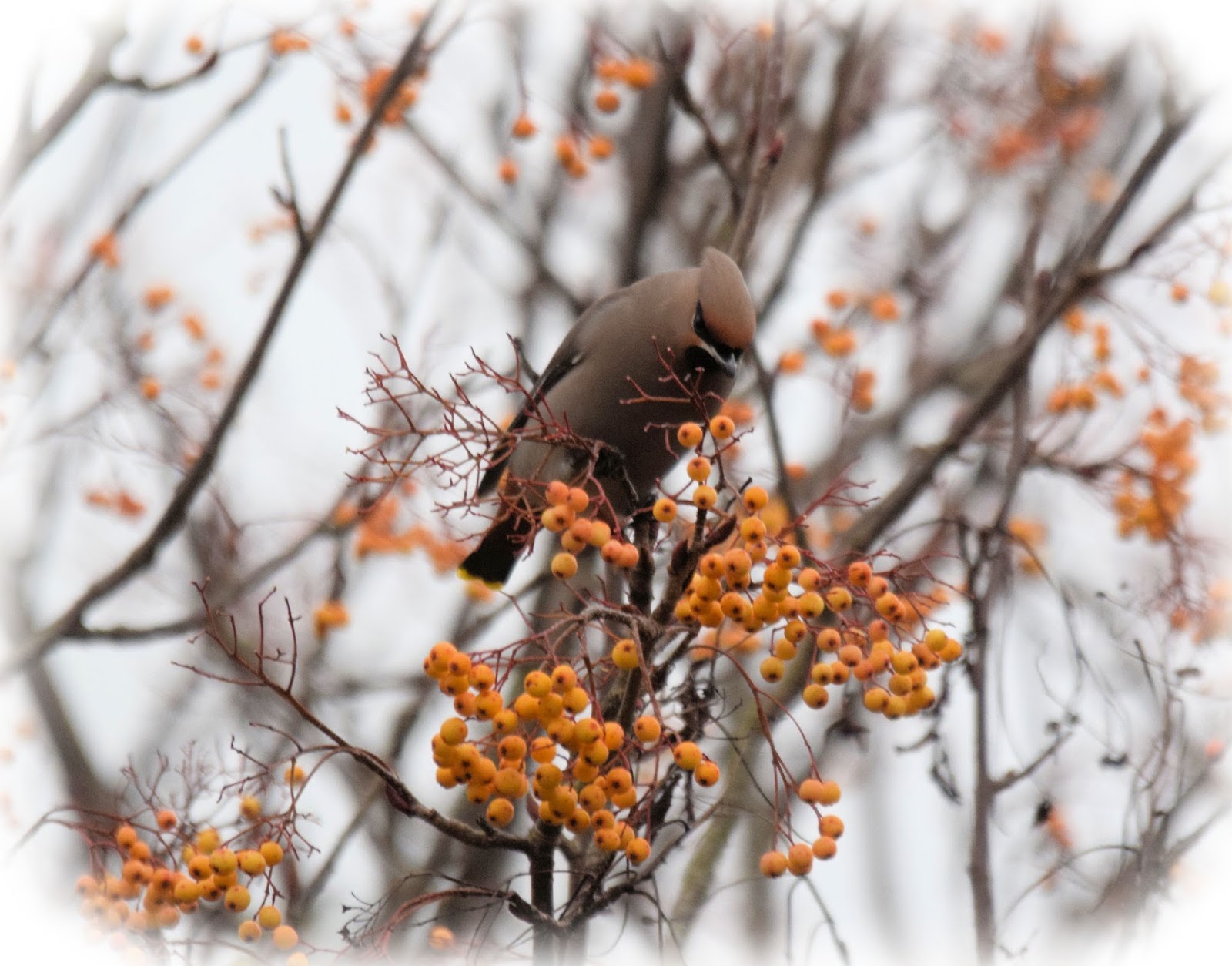
Third time lucky, still plenty of berries around, this small flock have been hanging around the trees in a small housing estate opposite a public house. As I arrived I could see the birds at the top of a tree. It appeared that they were rather partial to the yellow berries of a few Rowan trees and were swooping down from the treetops to take their fill of berries before returning to the treetops.


Fortunately these beautiful birds seem to be fairly tolerant of human presence, and the pointing of camera lens in there direction does not overly alarm them.

Just a matter of taking up a position fairly close to the berry tree and waiting. this particular flock only appeared interested in the yellow Rowan berries ignoring the red Rowan berries close by which the local Blackbirds and Starlings were taking, a quick grab and snatch visit by a Mistle Thrush also favoured the yellow berries.

Well worth the wait, the Waxwings swoop down into the Rowan tree, feeding appears frantic but the views are incredible. not long before they are off again returning to there high vantage point at the top of a Beech tree.


As I mentioned the local Blackbirds and Starlings were taking their share but were more interested in the Red Rowan berries, which provide a few photo opportunities.


But the star birds of the day were the Waxwings, so here's a few more images, hopefully it
will not be so long before our paths cross once again.


I may have to return for another visit if the sun shines and the berries last a bit longer, these yellow berries have nearly been consumed, but plenty of the red variety around.