Friday, 9 March 2018

Winter Storms !


Day One
The "Beast from the East" clashed with storm "Emma"  causing havoc around the country.

A week long period of heavy snow, all the more unusual for us in the south, I can't remember a prolonged period of snow like this for some time.

The initial euphoria of a winter wonderland landscape soon passes, and the reality of being housebound, cold, and generally feeling fed up soon sets in.
Fortunately this does not last for long, just five days in all, spring like conditions have returned now, the snow has disappeared as quickly as it appeared. The shrubs around the garden are showing signs of new life, crocuses are in bloom, Daffodils and tulips have burst through the thawing soil.

Winter Thrushes have dispersed back to the countryside

A review of the birds visiting the garden around the Pear tree during this period of  wintry weather threw up a few pleasant surprises.

I kept the bird feeders well stocked with apples in the hope of enticing a Fieldfare or two into the garden.  No such luck the only birds to appreciate them were the Parakeets, Starlings and Blackbirds.


A first for the garden, three Redwings landed briefly in the top of the Pear tree, allowing a quick photograph before they were off.

2 of 3 Redwing briefly landing in the Pear tree

The most exciting find for me was a very brief glimpse of a Song Thrush in the garden, I first caught sight of the bird flying into the ivy, and then one more brief view as it flew across the garden, landed briefly in the Weigela tree before moving out of the garden, couldn't focus properly in my excitement

This is one of those birds that seem lost to the suburban gardens, where in my youth they were quite common to see skulking around under the garden shrubs.

A bad photograph but you can clearly see that its a Song Thrush.

Song Thrush in the Garden. !!!
Just before the bad weather set in another Thrush sighting  at the top of the Pear tree again, this Time a Mistle Thrush, so that is three out of four possibilities and two new additions to the garden bird list in the form of Song Thrush & Redwing.

Mistle Thrush
There had been no sign of a wintering Blackcap in the garden all winter until the arrival of the snow, this male spent three days around the garden feeding on the fat balls not interested in the apples strangely. seems to have moved on now.


Wintering Blackcap
This was the first Greenfinch sighting in the garden all winter, driven in by the winter storms no doubt. ( Another bad photograph, inadvertently left ISO setting very high for some reason.)  but worth recording as a garden scarcity .

Greenfinch
A roving flock of Tits visited the garden on and off during the bad weather, Blue Tits, Great Tits and Long Tailed Tits, one sporting some bling.

Long tailed Tit.


Other regular sightings include the ever present flock of House Sparrows, Chaffinch, Goldfinch, Wood Pigeon, Collared Dove, Carrion Crow, Dunnock, Robin and  two sightings of the juvenile Sparrowhawk previously photographed, and a very brief view of a Wren.

House Sparrows in the snow


Goldfich
 There has been a " Charm of Goldfinch" that land briefly in the Pear tree late afternoon, I have counted  twenty one in the Pear tree.

Hopefully that will be the end of the wintry storms for us in the south of the country, looking forward to some warmer weather and spring.

Saturday, 3 March 2018

Garden Centre !


A walk down to the garden centre to replenish supplies for my bird feeders turned out to be a blessing in disguise, as I walked out into the car park I could see a small flock of birds in one of the fruit trees. Fieldfares, so intent on their feeding they seemed unperturbed by passers-by.

These winter Thrushs  are difficult to get near for a decent photograph usally for me, they seem to take flight the second you come into their view on most occasions.

As the " Beast from the East " takes its icy grip of the countryside these must have been desperate to get at the last remaining fruits on the garden centre trees. Not sure what the fruits were, possibly a type of "crab apple" or "Cherry apple" The Fieldfares were desperate to get at them.

I rushed home for my camera and quickly returned to the car park, they were still there, I parked up in a suitable position, not to close so as to interrupt their feeding.


 I noticed the next day as I  took my dog out for its early morning walk, even more Fieldfare had arrived into the local area, you could clearly see the birds scouring through the gardens looking for berries and fruit.

Their favoured food source is usally ground invertebrates, but as the ground becomes frozen, as in this case, they search for berries and fruit.

These will be returning to their breeding grounds very soon, late March ,early April , so it was nice to catch up with them one more time before they depart the country.

Does anyone know what these fruit/berries are, about the size of a cherry. ?


Thursday, 1 March 2018

" My Little Feathered Friend "


Last spring we were fortunate to accommodate a pair of Robins in an old nesting box hidden in the Ivy, close to our conservatory window. We watched them build their nest, rearing five young fledglings.

During this time we managed to befriend them by supplementing their search for food with some tasty live meal worms.

The Male in particular became very tame and responded to my "pursed lip" call, as I held out my hand with a few meal worms. even the female eventually overcame her fear and readily came to hand. You can't beat an interaction with a wild creature.

This was back in March 2017, so roll on now to late February 2018, I noticed a Robin watching me as I moved around the garden, could this be my old friend from last year,  I gave my pursed lip signal out of curiosity, the Robin seemed to respond, but I wasn't sure.

The next day whilst at the garden center I purchased a small tub of meal worms, but the Robin was nowhere to be seen and not noticed for a few days.

Finally I spotted  a Robin at the top of the Pear Tree, singing very loudly, was this my little feathered friend,  I approached the base of the tree and gave my signal, nothing, I tried again, and to my astonishment the Robin dropped from the top of the Pear Tree, a good thirty feet high and landed directly on my hand , gave me a look, and took a meal worm.

A very heart warming moment, it must be at least nine months since last we met, I did not really expect the Robin to remember me,  he obviously did.

Since this reunion he regularly waits for me outside the greenhouse now, where I give him a few Meal worms at the start of the day.


Phone picture of my little feathered friend

 He's managed to attract a new female mate, this one is very wary and will not come to hand as yet, she just sits close by watching the male in astonishment as he takes food from my hand, to be fair after he has had his fill he does take a few meal worms to her where he feeds hers as part of his courtship ritual.

The new female mate
There has been some initial nest building observations, not in  the nest box but next to it hidden deeper in the Ivy. but seems a little early and not a serious action.

The male watching the female

Unfortunately a cat has appeared and taken an interest in the Robins new nest position, I have discouraged the cat, and in doing so may have disturbed the female Robin, I have not seen any further  nest building activity.

Although my little feathered friend still seen regularly, and the female is still close by. 

Nest building will have to wait until the "Beast from the East" moves on, and the cat.


Thursday, 8 February 2018

Sprawk !!!


 I suppose that its inevitable that the  'Pear tree feeding station' in my garden will attract its fair share of predators, its a bit like a restaurant with a good variety of birds on the menu, something I do feel guilty about, but thats nature, and on those occasions when an Sparrowhawk does make a 'sortie', most of the birds make it to cover.

The ring of feathers found on the lawn on occasion, bear testimony to those that didn't make it.

The Sparrowhawks appear to show no fear and are quite at home in the suburban environment, I have witnessed several attacks around the Pear Tree whilst gardening, although they rarely linger, I have managed to photograph a few over the years.

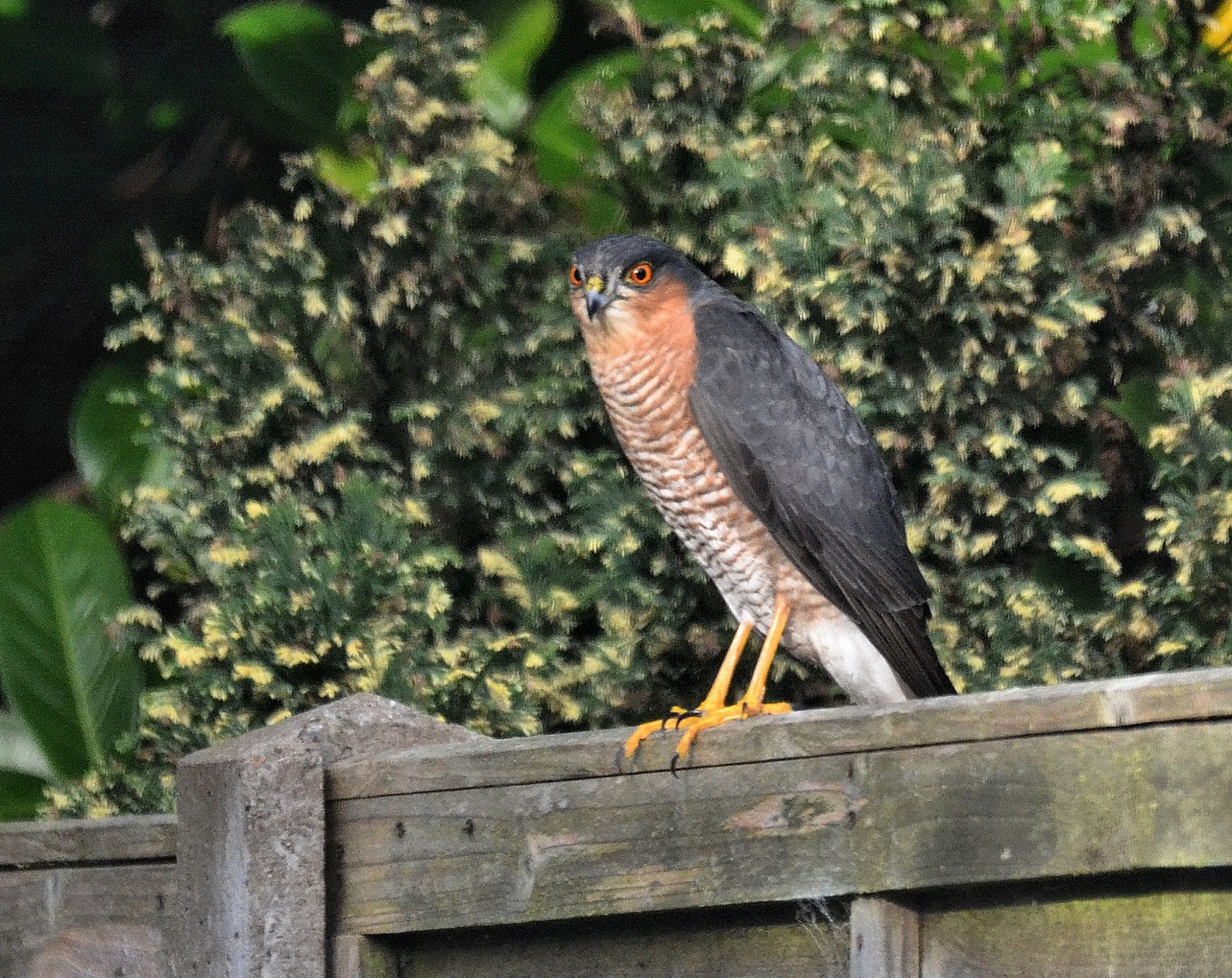
This is the latest Sparrowhawk to be photographed which I noticed  perched in the Magnolia tree at the bottom of the garden, didn't stay for long and was obviously looking for a meal.


I am pretty confident in identifying the adult birds, this is a juvenile, but juvenile male or female I am not so sure, leaning towards a juvenile male, nice looking bird though.

Here's a photographic record of some of the Sparrowhawks that I have managed  to capture.

This probable second year female or adult shown below was the first that I managed to photograph back in January 2013, staying some time in the bough of the pear tree as it devoured its meal.


 23rd December 2014 this fine looking male Sparrowhawk shown below, appeared from nowhere and landed on the fence in front of the feeders obviously scattering the  terror stricken birds on the feeders.


4th February 2015, possibly the same male again landed on the fence before flying off down the gardens.


Once again on 24th November 2015, a male Sparrowhawk, possibly the same individual was seen in the shadows of the laurels at the bottom of the garden.


Spectacular birds to watch.

Wednesday, 7 February 2018

Winter's walk at Dungeness


I always try and get at least one visit to Dungeness in the winter to see some of their specialties, with spring fast approaching I thought I might have left it too late, but with the recent cold spell, I needn't have worried, plenty of winter birds still in attendance.

This was also an opportunity to try out my new 'Scopac', the hopeful answer to my equipment carrying dilemma.

Dungeness is one of those reserves where a scope and tripod are essential if you wish to see some of the distant birds that frequent the various lakes/pools, I find it hard not to take the camera and zoom lens and the must have binoculars and of course  the lunch box and flask.

The Scopac fits neatly on your 'tripod and scope' allowing you to carry it comfortably on your back, with Camera and lens poised on my hip, binoculars around your neck, I was ready for all eventualities and not feeling to weird in the company of like-minded people.

My first port of call was the Hanson hide, on the ARC pool, not too crowded and plenty of wildfowl on view,  the more common wildfowl were quickly ticked off, Pocard, Tufted Duck, Teal, Shelduck, Gadwall, Wigeon, Shoveller, Coot and a Great Crested Grebe.

  My first Goldeneye of the season was soon picked out, a lovely Drake in the company of two females too distant for a photograph but fine views  through the scope.

On the far side of the lake opposite the hide, a Grey Heron stood patiently on the edge of the reeds, a Great White Heron was seen perched in one of the trees and  some nice views of a Bittern that fed along the edge of the reed-bed before melting  back into cover.

I can never resist the urge to  take a photo of these distant rarities, for me anyway.

 They never work always a  blurred tiny spec which no one but you would know it was there in the photograph, but always serves a little reminder that at least you saw it. hence the need for scope and tripod. There will be a few of these distant blurred photographs on this page, for that reason only.

Distant Bittern in front of the ARC hide

Bewick Swans have been reported of late here roosting on this pool, usally coming in at dusk and leaving early morning, so I wasn't expecting to see  any of these winter swans, fortunately for me and for some unknown reason two Bewick Swans returned to the pool and gave some reasonable views.


Bewick Swan
Plenty of Cormorants scattered around the islands,  and eventually the Black-Throated Diver made an appearance, but spending more time underwater than on the surface. the only photograph I could get was a rear view that shows nothing of interest, but there it was.

Black throated Diver.
The Common Kingfisher gave a couple of fly-byes,  but decided not to use the perches by the hide.
A small flock of Black Tailed Godwits flew in for a wash and brush up and the ever present Lapwings gave some fine displays when flushed by the local Marsh Harriers.

So with three good birds in the bag, Bittern, Bewicks Swan and the Black Throated Diver I moved on the main reserve, stopping for a quick view of the feeders by the entrance cottages in the hope of a Tree Sparrow  among the many Chaffinch and Great Tits feeding there. Just the one.

Tree Sparrow
My main quarry now was a hoped for view of a Smew, and if I was lucky the Drake or 'White Nun'
always a spectacular bird to see in the winter.

Most of the lakes seem occupied by the many Cormorants tat seem to have invaded the reserve, I did notice that a birder had tried to count the huge numbers reaching just under two thousand with more arriving all the time.


I did manage to pick out a few gulls, Great Black Backed Gull, Herring Gull, Common Gull, a definite Yellow-legged Herring Gull and a very tentative first winter Caspian Gull.
A few more Goldeneye, Pintail were also seen.

On to Christmas Dell hide where I quickly found the Smew, a fine looking drake and two Redhead females , but frustratingly on the far side of the pool, I did witness some interesting courtship behaviour, the female redhead kept circling the drake with its head and neck flat to the surface of the water, its tail and rump vertical . eventually the drake took the hint and holding the redhead underwater by the scruff of her neck fulfilled his role.

You can just make out the  White Nun drake and the redhead with its rump raised  in this very distant view.
Smew drake and Redhead in courtship
distant redhead Smew at rear
As a bonus  there was a Slavonian Grebe swimming very close to the Smew  along with  a single Little Grebe.

Another Bittern approached the hide in flight before dropping down into the reedbed. giving a slightly better if not shorter view.

Bittern at Christmas dell hide

The walk along  to Denge Marsh hide did not produce many offerings, another Marsh Harrier, a few Meadow Pipits and another distant Great White Heron.

Great White Heron.

As I walked back along the trail to the car park a Goldcrest flitted about in the willows next to the lake, true to form always on the move, but managed to get a snatched photo.

Goldcrest.
Just time for a quick sea watch before the sun went down was not very successful, although a couple of Gannets flying distantly by were picked out , a raft of Great Crested Grebes, is that the correct term ? and some unidentifiable Auks bobbing about in the waves.
No Black Redstarts for me on the power station walls just a couple of Pied Wagtails.

Pied Wagtail
All in all a successful winters walk, seeing a few good and scarce birds along the way, the 'scopac' performed well and I'm looking forward to using it in the future.