Wednesday, 22 April 2015

We have a new Baby !!!


I would like to have seen my daughters faces when they read this blog post title, but yes we have a new baby, the first baby bird of the year has fledged and is now exploring the garden.

We have had a pair of Robins in the garden since christmas, I have also seen on occasion the male Robin fly to the female in the garden shrubs and feeding her with insects and morsels of fatball, a very attentive male, I believe this is all part of the pair bonding.

 This is not an unusual occurrence as the female Robin stays on the nest incubating her eggs for about two weeks, and during this time the male will bring her food.

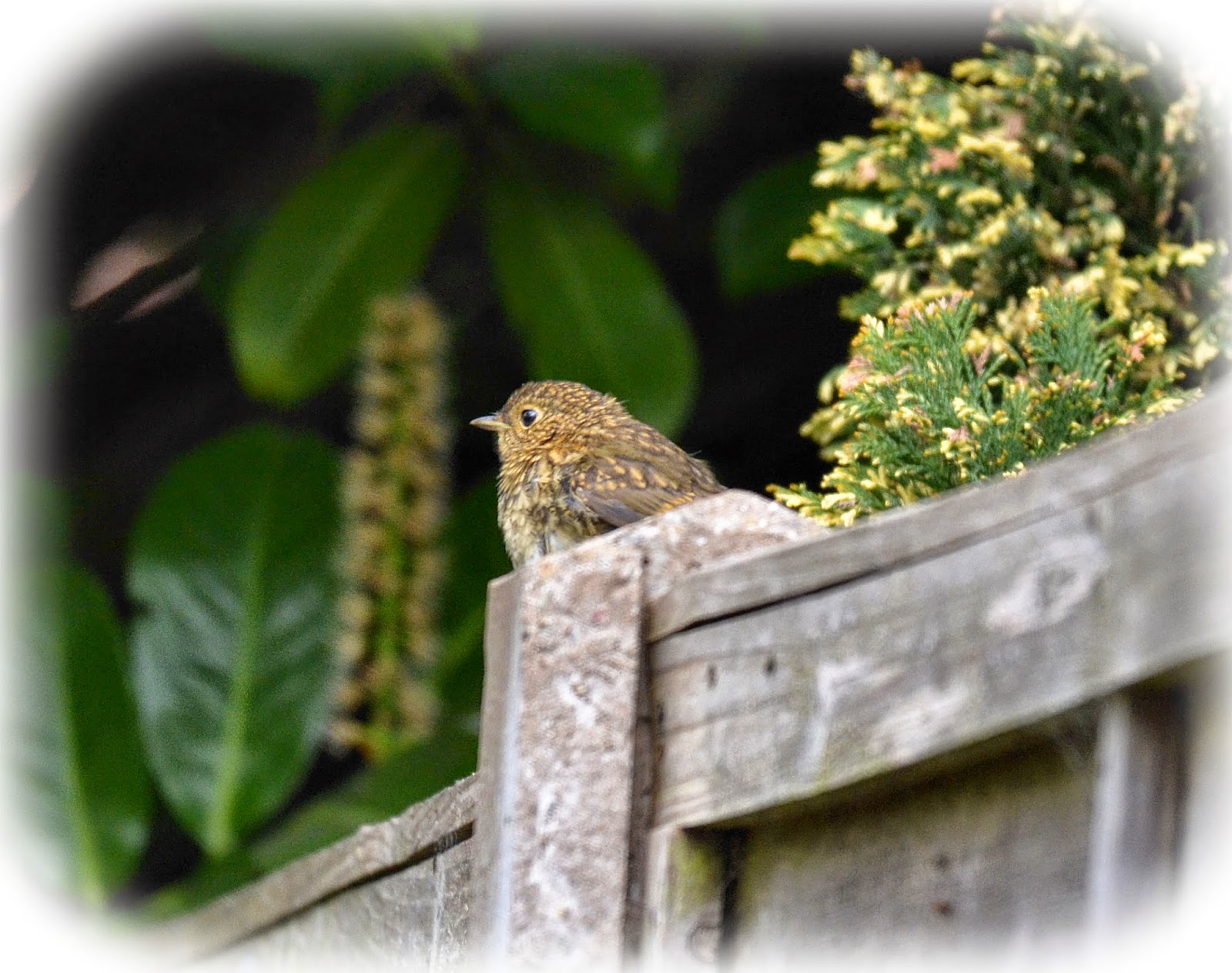
So today, 22nd April the first Juvenile Robin has fledged from its hidden nest somewhere at the bottom of the garden, curiously only one juvenile has been seen, maybe more will follow in the next few days.

The juvenile Robin does not get its red breast for about two months after fledging, this prevents it from being attacked by the parent birds as an intruder, Robins are very territorial.
The shape of the juvenile is quite unmistakable though.

My first glimpse was this morning when I heard the juvenile begging for food on the fence, and then mostly hidden views as the parent birds took food to the fledgling hidden within the shrubs.


I kept an eye on the birds throughout the day while I tinkered around in the garden, eventually when the parent bird was collecting food on the lawn, the fledgling flew out of its sheltered position and begged for food, allowing me to get a nice photograph to record the occasion.


Robin

More new arrivals should be on the scene soon.
.

Monday, 20 April 2015

Foul play !!!


I am always excited when a new bird appears in the garden, and a few weeks ago while working in the garden a Grey Heron flew low over the gardens, we are not talking country houses here, this is suburbia, I remember thinking to myself that Heron has entered my 'air space' I  can claim that  for my garden bird list.

A few days later, early in the morning, as I glanced out of my bathroom window, there was the Heron sitting on the ridge of my neighbors garage, our eyes met for the briefest of moments, before he silently lifted off and disappeared from sight, again I thought to myself, I am definitely claiming that for the garden list.

A few more days past, and glancing at my pond, I thought that's strange I haven't seen my prized Goldfish swimming around lately, on closer inspection I found two of my fish cowering within the weed of the pond, three other Goldfish had disappeared, and these are not small Goldfish, and I am very attached to these fish as my family will vouch, especially after the ups and downs of Goldfish care we have shared together over the last few years.

Then it dawned on me that Heron has been back a few more times than I have realized.

Okay so maybe not this individual, but in my minds eye, this is how I imagine him, standing on the edge of my very modest pond, with the look of the "Angel of Death", my admiration for this species is fast fading.


What's really annoying me also, apart from the fact of losing my prized goldfish, is that I purchased a very nice decoy heron, not a cheap plastic heron  but a realistic ornamental heron which has stood guard over my pond for the last few years. I was under the impression that a Heron would not come down to a pond where another Heron was feeding, How wrong was I.

In a surreal conversation with the fish keeper of the local garden centre, we discussed the loss of my goldfish to the Heron,  I mentioned the fact that  I had a decoy Heron in position  on my pond, and I was surprised that another Heron had come down to the pond.

"Well does it move around then" he remarked, I thought obviously not its ornamental,  he was being sympathetic, so I kept my thoughts to myself.
According to the fish keeper herons are very clever birds, not only do they memorize where all the ponds are in a local area, they can detect whether a decoy is real or not, the trick is to keep changing the position of the Heron, or I could invest in there latest laser triggered heron scarer at a cost of £140.00, I thanked him and said I would move the decoy Heron around.

I am now locked in a crazy battle like the reality programme " Bad Neighbors" each night  I go out to the pond to change the position, I find myself waking up early in the morning because I think the Heron is about to take my last fish.

Today the Heron blatantly landed on the garage roof at 14.30 hrs in the afternoon, I was alerted  by the manic screams of my wife to this fact, "the Heron, the Heron"

Maybe I should accept the inevitable, .... but I can't , this battle will continue.............


Friday, 3 April 2015

Oak & Nuthatch !

My local patch Ashenbank Woods has been providing me with some good woodland photographic opportunities as well as enhancing my knowledge and understanding of  woodland natural history.
I thought I would write a more in depth report on the Nuthatch nest site

I made an effort to learn a few calls from the woodland birds that  I might come across, the call of the Nuthatch was one of those, nothing special about that,  its quite an easy call to recognise, but it makes locating the Nuthatch a lot easier.


I have been trying for sometime to get a decent photograph of a Nuthatch, without much success, my luck  may have changed as I have stumbled across an active nesting sight, so if all goes well for the Nuthatches, the opportunity to study their nesting activities and the chance to get some photographs will be very welcome.

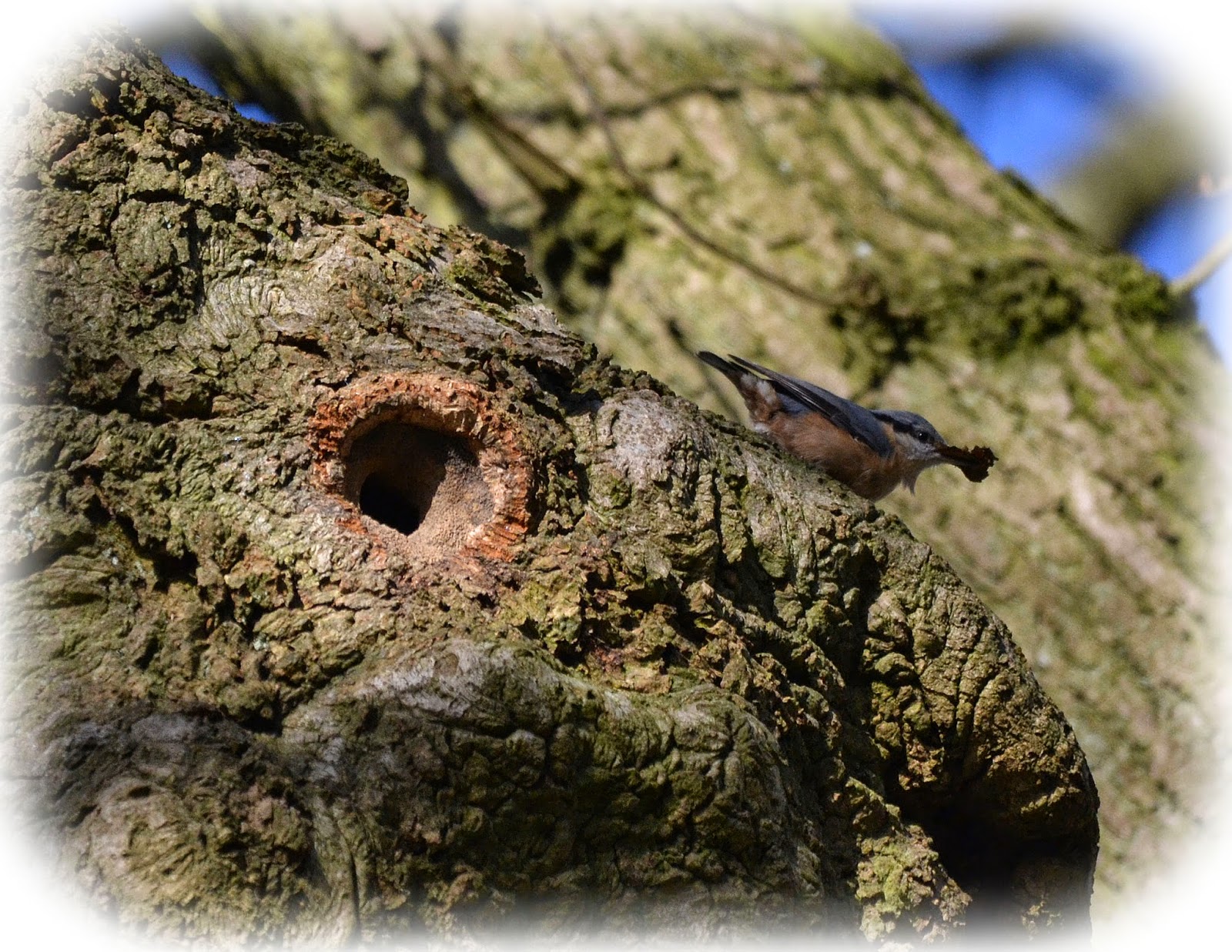
So this  is the Oak tree, the Nuthatches are nesting in what looks like an Oak Burl, approximately ten metre above the ground, indicated by the white star in the photograph


This is a close up of the Oak burl and the entrance to the nesting burrow, it looks like the bark has been chipped away all around the entrance, the actual entrance hole looks quite small, Nuthatches are known to reduce the size of entrance holes by plastering around the hole with mud, the optimum being about three centimetres .


I found this line drawing of various Nuthatch nesting burrows to give an idea of what's going on inside.


I first came across this site on 1st April , two birds were coming to the nest site, very difficult to tell which bird was male or female, I believe the only way to tell is the underwing colouring, which in the male is slightly darker orange , the female is lighter and more uniform, I have found this not to be very helpful in the field. The photograph below does show a slightly darker brick red to the underwing, so could this be the male ?

Possible male Nuthatch ( darker brick red underwing )


Both birds were seen arriving at the nest site with bark flakes in their beaks, which they quickly deposited within the burrow before quickly exiting. see photographs below and the diagram above.
It seems that the depth of the burrow can be controlled by the depth of the bark flake level, ensuring the optimum level is obtained, the eggs are laid in a shallow depression within the bark flakes.


Possible female nuthatch ( paler underwing blending into breast)
So it appears that three days later April 3rd, both birds are still bringing in bark flakes for the interior of the burrow. It will be difficult to know whether eggs have been laid if it gets that far, I suppose seeing the  parent birds bringing food to the burrow will indicate successful hatching. I will be keeping a watchful eye as I pass through on my daily walk through the woodland, a further report to follow as things hopefully progress.


Saturday, 28 March 2015

Hairy footed Flower Bee !

 Hairy-Footed Flower Bee (Anthophora plumipes)

This intriguing little bee first came to my attention last year when I was studying the Bumblebee's visiting the Flowering Blackcurrant (Ribes sanguineum)  in our garden.

And here we are once again after another successful breeding season.

Like a miniature Bumblebee, its their fast darting flight which usually attracts your attention, then as it slows down to hover in front of its selected nectar source, you have a window of opportunity to study it before its off, It appears very restless, there are only a few flowering plants at this time of the year so competition for the available nectar sources must be high.

I first noticed these Bee's in the garden a few weeks ago which ties in nicely with their emergence date of late February to early March, apparently the brown coloured males emerge first, closely followed two weeks later by the black coloured females. They have a single flight period which stretches from February/March to late May, no longer than three months, a very short life span, probably why they fly around so fast, time is short!

  They can be quite aggressive to other Bumblebees visiting the shrub, especially if they meet on the same flower, I watched a male see off a much larger Buff tailed Bumblebee, like a fighter plane buzzing a bomber, their speed and agility in the air is quite staggering. They are of course just defending their chosen territory in the hope that they can mate with a visiting female.

Male Hairy footed Flower Bee


Once the female has mated  nest building  can begin, this  usually occurs in the soft mortar of an old wall, although they are known to nest in the ground.

The female excavates a single burrow which can end in up to six to twelve oval cells, before sealing the cell the female deposits a supply of pollen, lays a single egg on top and seals the cell with soil or mortar, job done.

Female Hairy footed Flower Bee
Both male and female bee's develop into fully grown adults by the end of summer, they remain over winter in their sealed cells until the following spring, where they emerge once again.

I am yet to find one of these burrows, I suspect they are nesting in my neighbour's old brick built garage close to the flowering blackcurrant, its nice to see them once again.


Saturday, 21 March 2015

March around the Pear tree !

 21st March officially the first day of spring, although the 'met office' are implying that most people now consider the 1st  March as the beginning of spring.

21st is good for me.

The flowering blackcurrant in the garden is nearly at full bloom, the Bumblebee's are starting to visit, the first Bumblebee to visit was an Early Bumblebee worker  (Bombus Pratorum) closely followed by a queen Buff Tailed Bumblebee fresh out of hibernation.

Early Bumblebee worker

Buff Tailed Bumblebee queen

Not much has changed on the Birds around the garden, Goldfinches  are visiting in good numbers throughout the day and appear to become more tolerant of human activity. Chaffinchs have become very common, although their numbers seem to fade as the summer months draw near. The occasional Greenfinch is always a nice surprise as they are rarely seen in our garden.

Greenfinch


The Blackcap that has been with us  through the winter months still visits the garden, it has become less territorial and totally ignores the other birds on the feeders much to their relief I suspect.

Blackcap

We now appear to have a pair of Robins that have adopted our garden, hopefully they will find somewhere to nest,  a pair of Blackbirds have been seen gathering nesting material in the garden not sure if they are nesting within the garden. Other birds  have included Blue Tits , Great Tits and the occasional Long Tailed Tit.

Blue Tit

The male Sparrowhawk still trying its luck at ambushing the birds around the garden, fortunately unsuccessfully at the moment

Activity around the fish pond is increasing, several Common Newts have been seen, along with a mass of Frog spawn, which I must disguise, before my wife realises what she is looking at.

Looking forward to some proper spring sunshine.


Wednesday, 4 March 2015

The Bee's are back in town !!!

Its now the beginning of March, not quite spring yet, but the sun is shining, crocuses are in full bloom around our magnolia tree, and I have noticed for the first time this year, some insect action around the open flowers.

Last year I managed to get my head around BumbleBee identification, seeing most of the more common ones around the garden, thought I would try the same with Bee's this year.


Identification is not going to be so easy with these, on account of there being so many similar species.

I think this is one of the species of Adrena Mining Bees, but this is where it gets difficult, because of the sheer number of species.
I have narrowed it down to possibly 'Andrena Flavipes' or the 'Yellow Legged Mining Bee'.
These Yellow legged mining Bee's are usually the first to appear in early March, these Bee's are apparently 'Bivoltine' which means simply, that there are two generations, the spring generation are flying from March to May and the summer from June to September.They are also suppose to be quite common here in the south of the country, so that all fits.


The photographs are not really clear,but you can just about make out the yellow  hairs on the legs of this individual, which could make it the male, the hair on the females legs are denser and more prominent.

Confusingly, Honey Bees can be very similar in appearance.


The more I look at the photographs, the more I doubt my identification, 

I can say with some certainty its definitely a Bee, and its nice to see them back around the flowers collecting pollen.

 I think I need a close up of this one for a more positive identification, unless someone with more knowledge can shed some light on their identification.

Sunday, 1 March 2015

Little Owl !


I first came across this Little Owl site back in 2012, and have seen Little Owls here for the last four years, I was curious to know why I have never witnessed any successful breeding attempts, so after a bit of research, I think I have made sense of the erratic sightings.


The Little Owl begins its mating season in early February and ends as late as May, this ties up with the reappearance of the Little Owl where I usually see it within the wood. This is more than likely the male.

The male Little Owl patrols his territory and calls, partly to fend off other males from his territory but also to attract a mate. I have never heard this Owl calling, so maybe an earlier visit is needed.

Once a potential mate makes contact, pair bonding begins, this includes the Little Owl flying in pairs and sitting in the same tree, I have only once in four years noticed two Owls together in the same tree.

The next stage see's the female making a begging calls to her partner, which prompts the male to feed her prey that he has captured, this is important because it indicates to the female that there is enough to food in the area to support reproduction.

As the pair bond strengthens, the couple begin nest site visiting within his territory until a suitable nest site is chosen by the female.

And this is probably why I have never seen any signs of successful breeding at this potential nest site, the female not finding it suitable, to be fair the site is fairly near a woodland trail where dog walkers pass by, I suppose the disturbance from dogs doesn't help.

 I would love to know where the other  nest sites are though. here are a few images I have managed to capture, over the last few years.


I live in hope that a female will one day find this nesting site suitable.

Saturday, 21 February 2015

The Virtue of Patience !

One of the deciding factors for a trip to Rainham RSPB for me,
 is the fact that its a very short car journey, less than 15 minutes if there are no traffic jams, which means more time for bird watching and enjoying the marshes.

Today was not one of those days, the removal of the Dartford Tunnel toll booths and the subsequent road alterations was causing a traffic nightmare, and to make matters worse as I sat in the stationary traffic I realised that I had forgotten my binoculars and flask of coffee.

The weather forecast had given me just a small window of opportunity until mid afternoon, when heavy rain was expected, time was slipping by.

I eventually reached the tunnel, feeling slightly agitated now that I had made a wrong decision to come this way, but there was no turning back, and as I exited the tunnel into Essex, the sun suddenly broke through the gloom, I could feel the tensions slipping away.

A walk through the woodland trail was uneventful, but as I reached the woodland feeding station there was a good selection of birds feeding, I decided to make myself comfortable on the bench, a cup of coffee would have been nice, but the sun was shining and for most of the time I was alone undisturbed.


All the usual suspects were there, Chaffinch, Blackbird, Collared Dove, Great tits, Blue Tits were flying in snatching some food and flying off again.
This was my best attempt at a Blue tit in flight, 
they are just too fast.


I was trying to photograph the birds before they reached the feeders, I much prefer photographs showing the movement of birds.
but I'm still finding this very difficult.


Lots of Reed Buntings,with a few Robin and Dunnock feeding on the fallen seed around the base of the feeders.

Reed Bunting ( female)
Reed Bunting ( male)
Dunnock  ( Hedge Sparrow)
A Small group of Greenfinch seemed more hesitant in their approach,  but finally flew in to feed.


As I sat watching these birds flitting about in all directions, a movement at the back of the pool caught my eye and the hint of a white tail feather disappearing into the reeds, a possible Water Rail, more likely a Moorhen. I decided to sit and wait in the hope that it was a Water Rail, and that it might reveal itself again. Luckily there was plenty of avian action to watch.
Eventually after a long patient wait another movement in the reeds finally revealed the bird , a Water Rail in all its glory, and it walked out into the open area right in front of me.


It fed for a while around the feeders picking at the fallen seed, it must of caught sight of me, startled, it made a mad dash for the reeds and disappeared.


Content with this sighting, I moved off for a very pleasant walk around the marshes.
Little Grebe pairing up.
Teal
Drake Pochard

 Just made it back to the car as the first drops of rain began to fall, ironically, the journey back through the tunnel was clear and quick.

Wednesday, 4 February 2015

Winter Blackcap Revisited !

It's been a long time now, in fact not since the winter of 2013 has a Blackcap been seen in the garden,
 that's not to say that it's not been there, just not noticed.

So in the last few days of January 2015, coinciding with a particularly cold snap, there it was, early in the morning feeding on one of the apple halves I had placed on top of the feeding station, a fine male Blackcap.


 It's been around the garden now for the last few days, which leads me to believe that's its food source has become very scarce. 


It's become very protective of these apples, it's almost as if  its set up a territory, because it will not tolerate any other small bird near its food supply. The strange thing is that apart from the Blackbird and Starlings, which it sensibly stands aside for.


 No other small bird is really interested in the fruit, but its still determined to drive away the finches and Tits that are trying to feed on the sunflower hearts close by, and these are not even trying to compete for the fruit.

This aggression has led to Chaffinches being chased back to the pear tree, Goldfinches and house Sparrows scared off the sunflower heart feeder and an aerial skirmish with the local Robin. You can just make out the Blackcap at the bottom of the picture.


Attacks can come from all angles.


Its  been three days now and the Male Blackcap still spending most of the day around the apples.


Blackcap has become extremely aggressive, driving all small birds from the garden, this Goldfinch was feeding on the sunflower hearts which the Blackcap was not happy about, and its not even feeding on the sunflower hearts.


As I was watching the Blackcap guarding his apple, a movement in the ivy next to the patio window caught my eye, a female Blackcap, very shy, made no attempt to approach the apples or the male.


Even after removing the remains of the apple skins the Male Blackcap still reluctant to relinquish its food supply.


Day 5 and the male Blackcap arrived at the apple just after daybreak, where its been most of the day. 


Had a lucky escape as the local male Sparrowhawk fence hopping along the gardens arrived on the fence, surprising all in the garden,

including me.
 the Blackcap made a hasty retreat.


While watching the Blackcap, I was hoping the Wren might make an appearance, but no more sign of it, I did catch a glimpse of this Long tailed tit feeding on the Pear tree.


As this day draws to an end, as I glanced out the window, the blackcap was back again, looking very cold and fluffed up like a ball.


Its been interesting watching it these last few days, I was quite surprised how aggressive its been for a small warbler.
Hope it makes it through the winter and returns to its breeding grounds, probably back to Germany or there about.