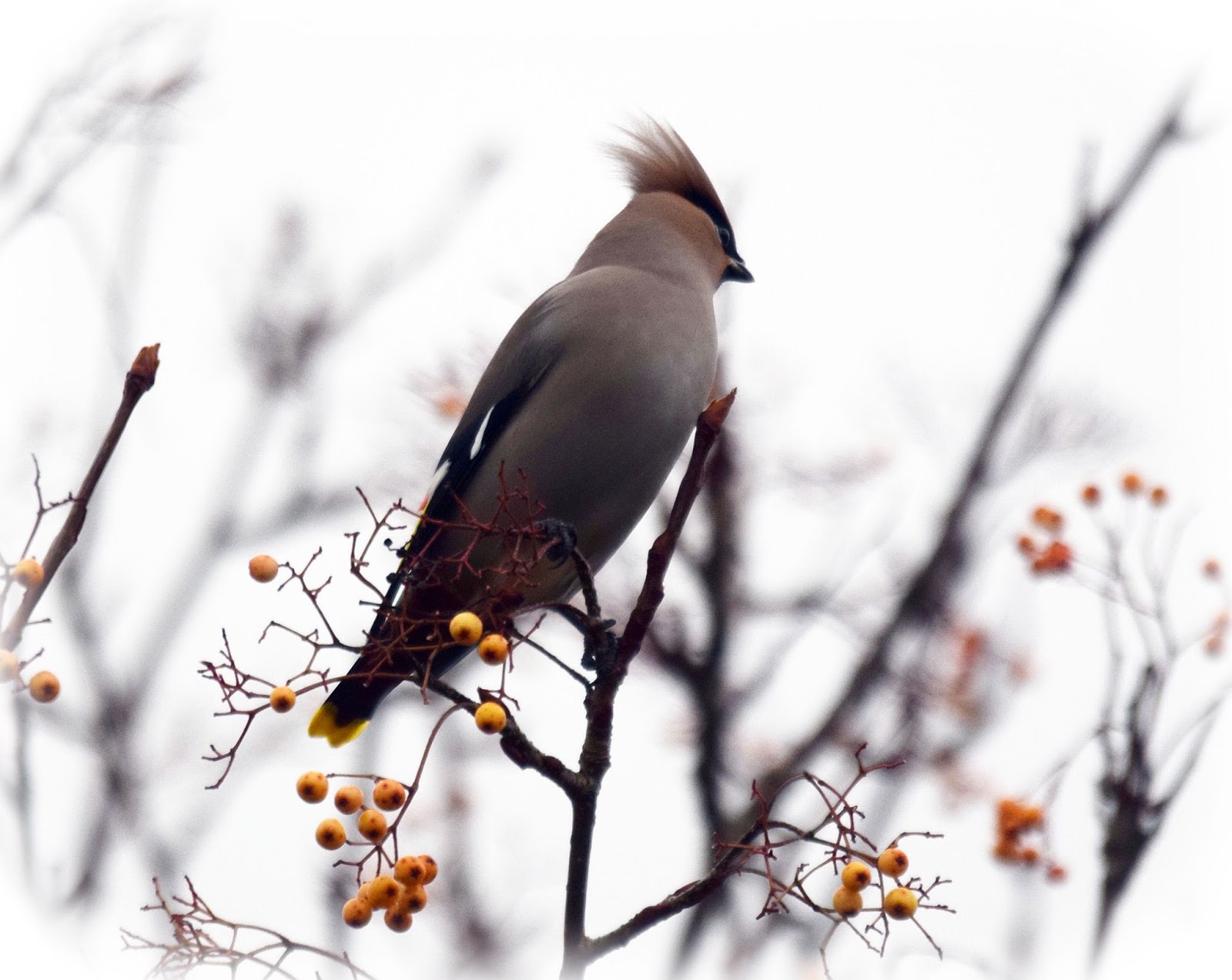
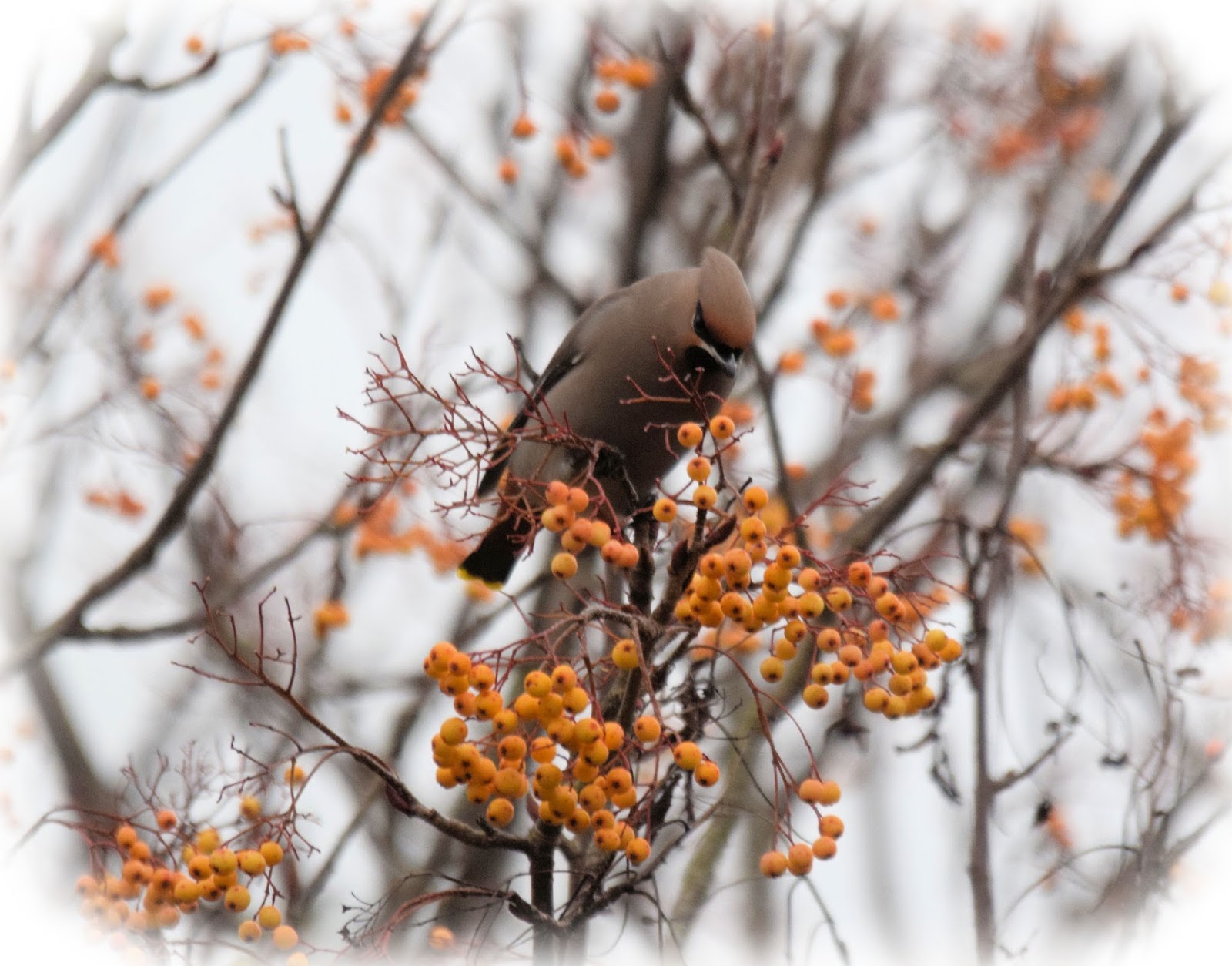
Monday, 23 January 2017

Invasion of the Berry Snatchers !


The Bohemian Waxwing, one of those 'must see' birds that visits our shores from Scandinavia each year seeking out the winter berries that our local Thrushes and Blackbirds have been relying on to get them through the cold winter months.

Early winter and reports start filtering through from Northern observers. The Waxwings have arrived, as the winter progresses, some eventually turn up down here in the south of the country.

I have heard the term 'Irruptive species' associated with the Waxwing, usally when large numbers of Waxwings arrive in the country, and this could be one of those years because there appears to be a lot of Waxwings arriving here at the moment.

I spent the early days of January visiting a small influx of Waxwings that were raiding Berry trees at Rochester at the most twelve birds, feeding on the yellow berries of some Mountain Ash trees.
I spent a few hours trying to get some photographs which I posted in the previous blog entry.

Then unbelievably, a large flock turned up at the bottom of my road, the number seems to fluctuate each day, averaging about fifty birds and at their most eighty four.

This large flock that turned up in Northfleet spent a lot of time roosting in some tall Silver Birches close to their favoured feeding area, the trees they were feeding in are very sparsely covered in berries from what I could see, but the flock has been in the area for over a week now so the berries on offer must be attractive to the Waxwings, also noticed a small flock of Redwings feeding on the same trees.

The trees they are visiting are quite spread out and the birds appear a bit flighty, the Waxwings  have a reputation for allowing a close approach, but I think the local photographers have pushed their luck a little too much.

Most of my photographs have been a little distant, but there close attendance to me is to much to resist.

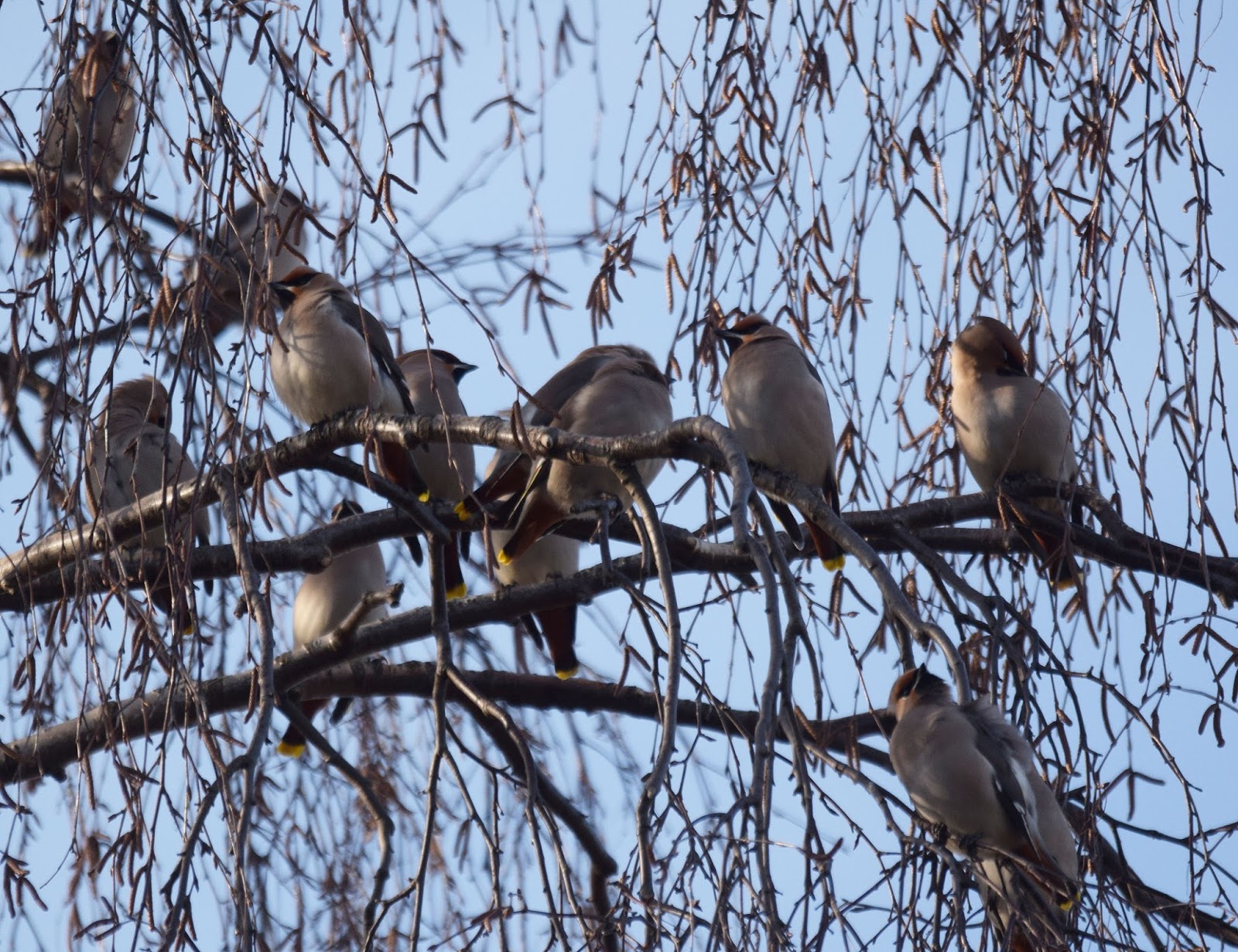


I made another visit to Rochester to see if the Waxwings here were still feeding on the Mountain Ash berries opposite the Bounty pub. They were there but once again roosting in the tall trees in the pub car park, fortunately the sun was shining on them allowing a few heavily cropped photographs.


Finally to finish off my Waxwing Portfolio, I thought I would use this opportunity to record some images I took back in January 2013, another good year for Waxwings, these turned up in the grounds of the 'Holiday Inn' at Dartford in Kent.


I don't think I will ever tire of watching these beautiful birds, I will look forward to next year, hopefully they will reach us here in the south again.


Wednesday, 11 January 2017

Waxwings at Last !!!


At last the Waxwings have finally found their way down south and appearing in good numbers at some sights.
I have been teased by the appearance of just three Waxwings which turned up here in Kent at Rochester just before christmas, twice I went looking, but to no avail, very frustrating as it's been a few years since last they visited here in any great numbers.


After a short absence they have reappeared in early January with a few more of their brethren, now numbering ten.

Third time lucky, still plenty of berries around, this small flock have been hanging around the trees in a small housing estate opposite a public house. As I arrived I could see the birds at the top of a tree. It appeared that they were rather partial to the yellow berries of a few Rowan trees and were swooping down from the treetops to take their fill of berries before returning to the treetops.


Fortunately these beautiful birds seem to be fairly tolerant of human presence, and the pointing of camera lens in there direction does not overly alarm them.

Just a matter of taking up a position fairly close to the berry tree and waiting. this particular flock only appeared interested in the yellow Rowan berries ignoring the red Rowan berries close by which the local Blackbirds and Starlings were taking, a quick grab and snatch visit by a Mistle Thrush also favoured the yellow berries.

Well worth the wait, the Waxwings swoop down into the Rowan tree, feeding appears frantic but the views are incredible. not long before they are off again returning to there high vantage point at the top of a Beech tree.


As I mentioned the local Blackbirds and Starlings were taking their share but were more interested in the Red Rowan berries, which provide a few photo opportunities.


But the star birds of the day were the Waxwings, so here's a few more images, hopefully it
will not be so long before our paths cross once again.


I may have to return for another visit if the sun shines and the berries last a bit longer, these yellow berries have nearly been consumed, but plenty of the red variety around.

Wednesday, 21 December 2016

Just a Grey Squirrel !


I know that Grey Squirrels  are not the most popular of mammals, blamed for the demise of the more popular Red Squirrel, but this is the only Squirrel  I'm likely to see here in Kent.

 This one presented a nice photographic opportunity, It's a shame the reflection in the pool was not a little stronger, and the subject a little rarer.


 Unusually, I saw several Greys eating Hawthorne berries and one even eating Rose Hips which makes a change from the sweet chestnuts  I usally see them eating, maybe these make them thirsty, certainly took on a lot of water while I was watching.

Not much more I want to say about these Greys, so probably my shortest blog entry ever, just wanted to record the image which I quite liked.


Sunday, 18 December 2016

Winter Buntings !

 It's not often a visit to a Reedbed does not reveal one of these smart looking Buntings, The Reed Bunting, in particular the cock bird as shown in this photograph are pretty unmistakable, even in their winter plumage, the female not so distinctive but still nice to see.


As I sat on a bench watching this cock Reed Bunting decimate the head of a Phragmite it brought to mind my first ever sighting of this species for me back in 1986 when I first began taking a keener interest in bird sightings, not such a nice place, the reed bed alongside Long reach sewage works on the bank of the River Thames near Dartford, I remember even now, thirty years later, the excitement of seeing a cock Reed Bunting atop of a reed, singing its heart out, little did I realise that it was a common bird of the Reedbeds, now I hardly give it a second glance except to acknowledge the bird as a Reed Bunting.

Strange how a memory is triggered by a sighting, seems like only yesterday.


 On the other hand, how annoying is it when engrossed on a DIY project and I find myself wondering what tool was it, that I have come down to the garden shed to retrieve,
 only to remember on the walk back to the house empty handed. what's that all about !

Here's a few images of the Hen Reed Bunting, not so distinctive as the male and blends into its reed bed habitat perfectly.


Looking on the bright side I can still identify most of what I see on my daily excursions. so not too much to worry about.


Always nice to see a bird in its natural surroundings.

Saturday, 3 December 2016

An Unlikely Face Off !


The European Robin, re-established as our national bird earlier this year, often seen in the woodlands, a garden favourite and often taken for granted.
 Life appears harder for the Robin in the marshlands where food supply is scarcer to find in these cold winter months.


Here's a pictorial observation of a plucky little Robin made the other day, after a particularly cold and frosty night.

The so called arena was a feeding station in the reedbed adjacent to the woodland at Rainham RSPB.
a good place to sit awhile and watch the birds coming and going, Greenfinch,Goldfinch, Reed Buntings, Dunnock, Collared Dove, Great Tit, Blue Tit, occasionally a Great Spotted Woodpecker arrives, and last year a Water Rail was seen feeding around the base of the feeders. But today's life struggle was this brave little Robin which caught my eye.


This Robin stationed itself on a convenient perch next to the feeder, being a ground feeder it didn't try and take seeds from the feeder itself, it was more interested in the spillage at the base of the feeder, which it made claim to, occasionally chasing away the female Buntings and Dunnocks.


Now I know that the Robin has a reputation for being a bit feisty to other Robins, especially when defending a territory, but this was even a very brave Robin or very foolish. I remembered a blog from Rainham last year of a Brown Rat attacking a Starling and dragging the unfortunate bird down a hole screaming.


 A Brown Rat slunk in from the shadows,  surprisingly the Robin held its ground, the Brown Rat edged ever closer, the Robin stared back, a face off , no one was giving ground, the Rat appeared massive against the Robin's tiny frame.


As the Brown Rat tentatively started to nibble at the spilt grain, the Robin edged closer, I had a bad feeling that this was not going to end well. The Robin was very agitated


Time after time the feisty little Robin launched into an attack on the Rat, each time the Rat would scurry off, only to return  a few seconds later.


                           Each time the Rat would scurry off, only to return  a few seconds later.


Just when it appeared that the Robin had driven the Brown Rat away


He returned with reinforcements !


At least the Robin lived to fight another day.